
The cost of daycare and nanny care flips based on how many kids you have. We break down the real numbers.
![fa68d3cf597342bf94290a8970129c0b[1]](https://parentworth.com/wp-content/uploads/2026/05/fa68d3cf597342bf94290a8970129c0b1-1024x683.png)
For one child, daycare is three to five times cheaper than hiring a nanny. But add a third child, and a nanny often becomes the cost winner. The inflection point isn’t hourly wages: it’s how the cost structure changes as your family grows.
Most parents think the daycare vs nanny decision comes down to personal preference. It doesn’t. It comes down to math. And the math changes entirely depending on how many kids you have. If you’re making this decision, the number of children you’re planning to care for is the single most important variable. Everything else . flexibility, socialization, reliability . comes second to cost for most families.
This guide walks through the real numbers, region by region, family size by family size. By the end, you’ll know exactly which option wins for your situation.
What is daycare vs a nanny?
These two childcare models look different on the surface because they operate on completely different cost structures.
Daycare is center-based or home-based group care. Your child joins other children in a professional facility with trained caregivers, a curriculum, structured meals, and organized activities. You pay per child, per month, with no discounts for multiple siblings.
A nanny is in-home, one-on-one care. You hire an individual caregiver who comes to your house, works on your schedule, and cares exclusively for your children. You become the employer. You handle payroll, taxes, and benefits. But here’s the key: when you add a second or third child, you don’t pay double or triple the rate. You pay a modest bump (usually $2-3 per hour per additional child).
That’s the cost structure difference that makes this decision interesting. One scales by headcount. The other scales by family.
Cost comparison by family size: Where daycare wins and where the math flips
The break-even point between daycare and nanny care depends entirely on how many children you have. This is the insight that separates good financial decisions from bad ones.
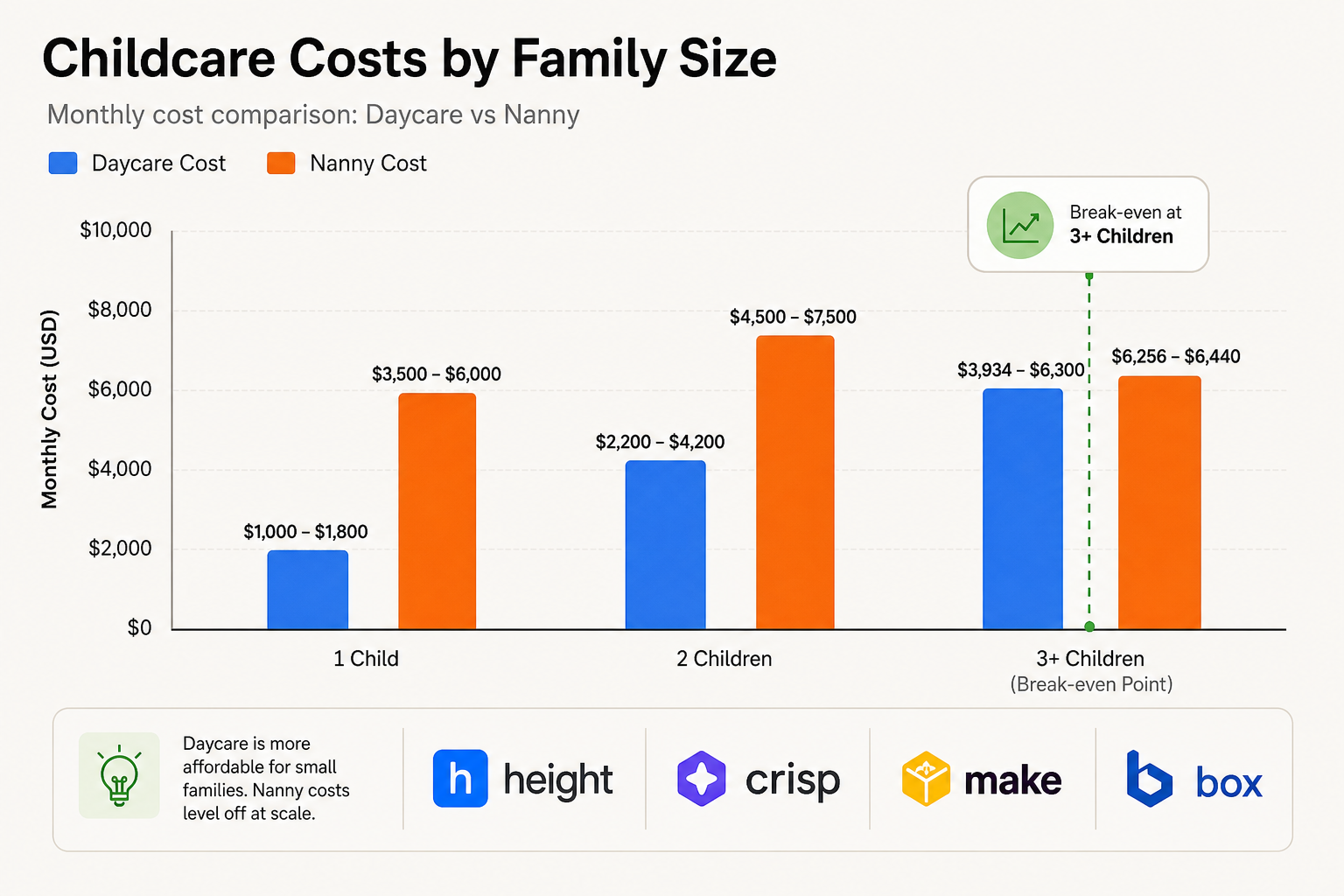
One child: Daycare is cheaper (usually 3-5x less expensive)
For single-child families, daycare wins decisively. It’s not close.
Daycare costs between $800-$1,500 per month for a preschool-age child, or $10,000-$18,000 per year. If you have an infant, expect the higher end: $1,200-$2,500 per month. The trained staff, meals, activities, and curriculum are all included.
A nanny costs $3,000-$5,000+ per month, or $36,000-$60,000+ per year. This breaks down to $18-$30 per hour, plus 10-15% in employer taxes and benefits on top. Your actual monthly cost is usually $3,500-$6,000 when you factor in the full employer burden.
The gap: Daycare saves you $15,000-$30,000 per year for a single child.
When might a nanny make sense? Only if you need highly specific scheduling (evenings, weekends), require a newborn specialist, or strongly prefer personalized in-home care. But the cost premium is real, and most single-child families can’t justify it on budget alone.
Here’s what the numbers look like in a cleaner format:
| Cost Factor | Daycare | Nanny |
|---|---|---|
| Monthly care | $1,000–$1,800 | $3,500–$6,000 |
| Annual care cost | $12,000–$21,600 | $42,000–$72,000 |
| Included with cost | Curriculum, meals, social interaction | One-on-one care, flexible schedule |
| Hidden costs | Registration $200–$500, supplies $150–$350, late fees | Employer taxes (10–15%), paid leave, benefits |
Two children: The tipping point (daycare still ahead, but margins narrow)
This is where the math starts to get interesting. The cost dynamics shift.
Daycare for two children costs $2,200-$4,200 per month, or $26,400-$50,400 per year. Here’s the critical piece: there are no family discounts. You pay full tuition for each child. Add a second child to daycare, and your cost nearly doubles.
A nanny for two children costs $4,500-$7,500 per month, or $54,000-$90,000 per year. But the math here is different. The industry standard is to add only $2-3 per hour per additional child, not a second full salary. In Southern California, for example, if a nanny’s base rate is $30 per hour, adding a second child brings it to $32 per hour, roughly $5,890 per month. Not $6,000 more.
At this family size, the gap narrows considerably. In high-cost urban areas (Southern California, New York, major metros), two children in daycare can easily exceed $4,000-$5,000 per month, bringing nanny costs into competitive territory.
Geographic variation matters here. In lower-cost areas, daycare still wins decisively. In expensive cities, the two options are within the same ballpark, and your local costs become the deciding factor.
For two children, daycare typically still comes out ahead. But this is the moment to do the math for your specific location, because the financial advantage is shrinking.
Three or more children: Nanny becomes cost-competitive (or wins outright)
This is where the cost structure completely flips.
For three children, daycare costs $3,934-$6,300 per month, or $47,000-$75,600 per year. Each additional child adds full tuition. There are no economies of scale with daycare. Three kids means three separate monthly bills.
A nanny for three children costs $6,256-$6,440 per month, or $75,000-$77,000 per year. The cost increase from two to three is marginal: just another $2-3 per hour. That small hourly bump adds up to only a few hundred dollars per month.
Now do the per-child math. Daycare: roughly $1,300-$2,100 per child per month. Nanny: roughly $2,085-$2,147 per child per month. They’re nearly equivalent. And at the upper end of daycare pricing (common in expensive cities), a nanny is actually cheaper.
Three children is the crossover point. Many parents miss this because the assumption “nanny is always expensive” feels true for one or two kids. It stops being true once you have three.
Hidden costs: What parents usually overlook
Both options have costs that extend far beyond the sticker price. This is where families get surprised.
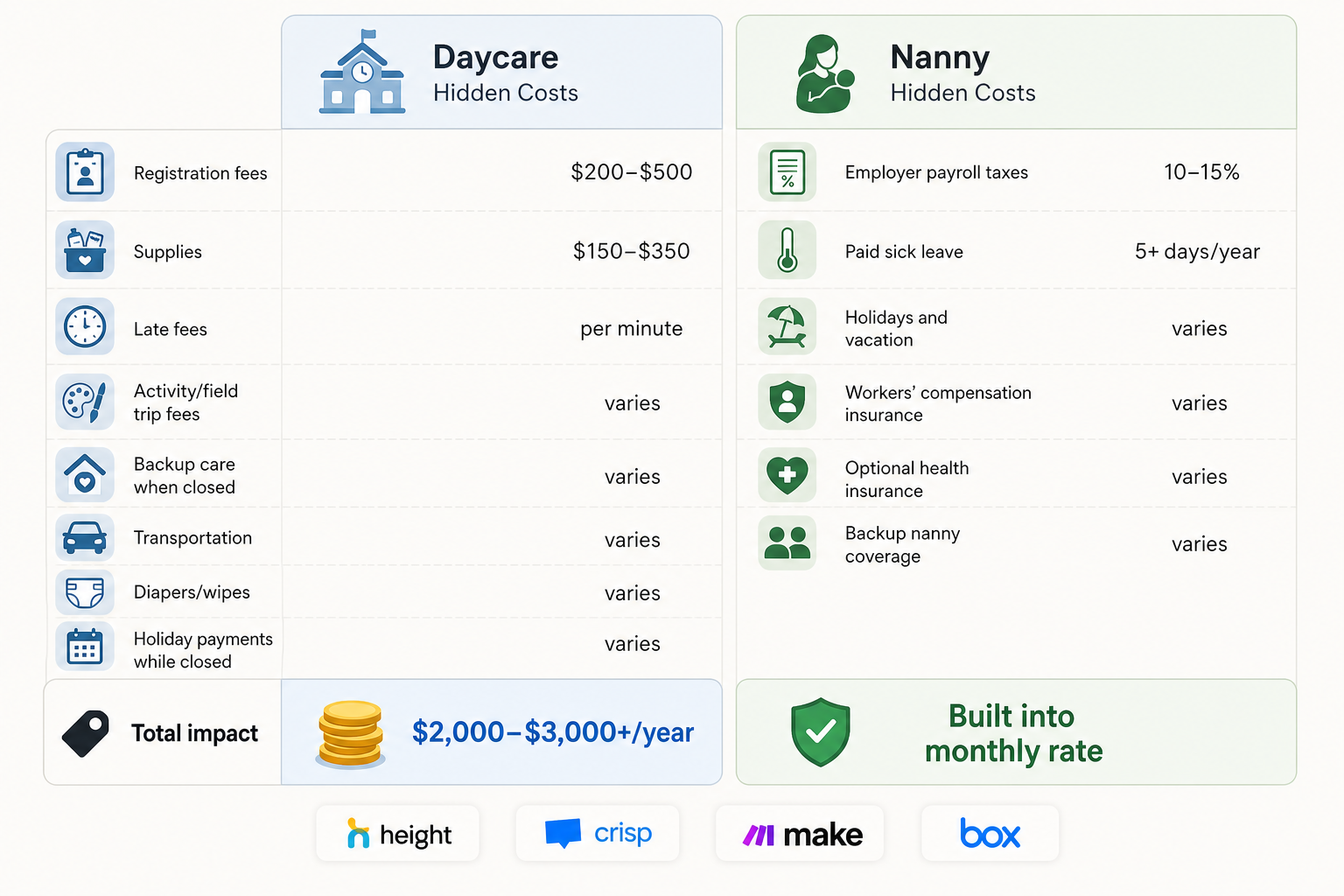
Daycare hidden costs (easier to underestimate)
Daycare fees aren’t just the monthly tuition. Parents consistently underestimate the add-ons.
Registration and enrollment fees run $200-$500 per child per year. Supply and material fees add another $150-$350 per child annually. Many centers charge extra for diapers and wipes, especially for infants. Activity and field trip fees accumulate throughout the year.
Late pickup fees are charged per minute, and they add up fast. Miss pickup by 10 minutes regularly, and you’re paying an extra $100-200 per month. When centers close for professional development days, holidays, or illness outbreaks, you still pay full tuition and have to find backup care. Transportation to and from the facility is your burden.
All told, these hidden costs can add $2,000-$3,000 or more per year per child. They’re not optional. They’re embedded in how daycare operates.
Nanny hidden costs (more predictable but mandatory)
Nanny costs look cleaner because most of the “hidden” fees are built into the quoted monthly rate. But they’re mandatory.
Employer payroll taxes (10-15% on top of gross wages) are legally required in most states. California law mandates a minimum of 5 days paid sick leave per year; other states expect paid leave too. Nannies expect paid holidays and vacation. Workers’ compensation insurance is mandatory in most states. If you offer health insurance, that’s additional.
The key difference: These costs are mostly transparent and built into the quoted rate. You’re not hit with surprise bills. The total is higher, but it’s more predictable.
Here’s the real insight: Daycare has hidden surprise costs scattered throughout the year. Nanny costs are higher, but you can budget for them because they’re mostly known upfront.
Beyond cost: Flexibility, socialization, and lifestyle factors
Cost isn’t the only consideration, but it’s the primary one for most working parents. That said, other factors can shift the decision even if the math favors one option.
Flexibility and schedule: A nanny offers complete flexibility for weekends, evenings, and custom hours. Daycare has set operating hours and closure days. If your work schedule is unpredictable, a nanny removes logistical stress.
Socialization: Daycare provides structured peer interaction, which has developmental benefits. Your child attends story time, group activities, and interacts with other kids daily. A nanny provides one-on-one care, which means more attention to your child but less social exposure unless you arrange regular playdates.
Structured learning: Daycare offers a curriculum, structured activities, and educational programs. This appeals to parents who want professional oversight of early learning. A nanny provides customized care, which works well for some families but is less structured by default.
Parental control: With a nanny, you set all rules, control diet, activities, and media. You have maximum flexibility in how your child spends the day. Daycare follows professional standards, which some parents find reassuring and others find restrictive.
Reliability: Daycare has backup staff. If one teacher is sick, the center stays open. A nanny calling in sick is a crisis. You need a backup plan.
Commute stress: Daycare requires drop-off and pick-up runs, adding time pressure to your day. A nanny comes to your home, eliminating commute time and coordination stress.
None of these factors override cost for most families. But if you’re in a two-option zone (like two children in a high-cost city), these lifestyle factors become the tiebreaker.
Making your decision: Which option is right for your family?
The numbers tell a clear story.
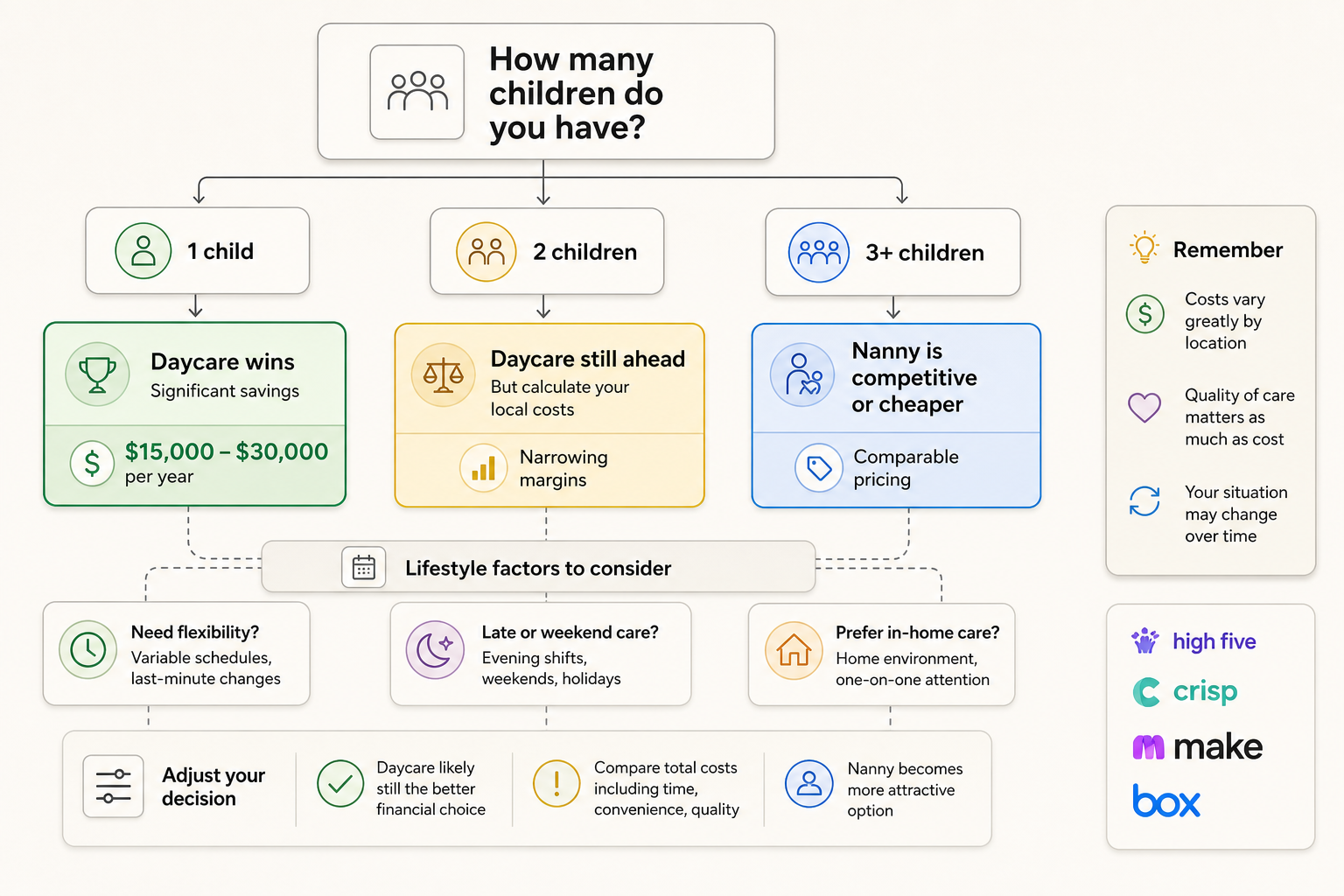
Choose daycare if: You have one child, budget is tight, you value structured learning and peer socialization, you need reliable backup care (no sick-day crises), and you can manage set drop-off and pick-up times. For a single child, daycare saves you thousands per year.
Choose a nanny if: You have two or more children (especially three or more), you need schedule flexibility (irregular work hours, weekend care), you strongly prefer in-home care and one-on-one attention, or you have specific needs like multiple languages or special dietary requirements.
Here’s the math at a glance:
- 1 child: Daycare wins by $15,000-$30,000 per year
- 2 children: Daycare wins, but margins narrow (check your local costs)
- 3+ children: Nanny often wins or is cost-equivalent
This is the decision framework. If you have one child and a reasonable daycare option, daycare wins. If you have three or more children, run the nanny numbers because you might be surprised.
If you have two children, calculate your specific local costs. In expensive cities, the break-even point may be closer than you think. Some families benefit from a nanny share (split cost with another family), reducing the nanny price by 40-50%. Others find part-time daycare, which trades off cost savings for reduced flexibility.
The bottom line: The right choice depends on your family size, budget, and lifestyle needs. Not emotion. Let the numbers guide you.
Frequently Asked Questions
At what point does hiring a nanny become cheaper than daycare?
For one child, daycare is typically 3–5 times cheaper than a nanny. With two children, the gap narrows significantly depending on your local daycare costs. With three or more children, a nanny often becomes cost-competitive or cheaper because the hourly rate only increases by $2–$3 per additional child, while daycare charges full tuition per child.
What are the hidden costs of daycare that parents miss?
Hidden daycare costs include registration/enrollment fees ($200–$500 per child per year), supply fees ($150–$350), activity and field trip charges, late pickup fees (charged per minute), backup care when centers close, transportation, and full tuition payments during holiday closures. These can add $2,000–$3,000+ per year per child.
What are the hidden costs of hiring a nanny?
Nanny hidden costs are mostly built into the quoted rate but include employer payroll taxes (10–15%), paid sick leave (minimum 5 days per year), holidays and vacation pay, and workers’ compensation insurance. These are more predictable than daycare surprise fees because they’re mandatory employer expenses.
Does a nanny cost more if I have multiple children?
A nanny’s rate increases only slightly with additional children (typically $2–$3 per hour per child), unlike daycare where each child requires full tuition. This is why a nanny becomes cost-competitive with three or more children.
Can I find an affordable nanny alternative?
Yes. Consider nanny shares (splitting one nanny’s cost with another family), part-time daycare combined with family help, or au pair programs. These hybrid approaches can offer more flexibility or affordability than either pure daycare or solo nanny care.
Is daycare or a nanny better for my child’s development?
Daycare provides structured learning and peer socialization, supporting social and academic development. A nanny provides one-on-one attention and flexible scheduling but less peer interaction unless you arrange playdates. The right choice depends on your child’s personality and your family’s lifestyle needs.
How much does daycare cost on average?
In the U.S., full-time daycare typically costs $800–$1,500 per month per child ($10,000–$18,000 per year), with significant regional variation. Infant care is more expensive ($1,200–$2,500/month) than preschool ($975–$1,800/month). Major metro areas can cost 2–3 times the national average.