A basic audio baby monitor has a list price of about $40. A sock that reads your baby’s pulse and oxygen, paired with a camera and an annual plan, comes to about $580 over two years. Both tell you when your baby wakes up. The question is what the other $540 buys.
For a lot of parents the honest answer is a surprise: it doesn’t buy safety. US safe-sleep guidance from the National Institutes of Health says no product can prevent SIDS, and that heart, breathing and motion monitors are not a way to detect it. That makes a premium monitor a convenience purchase, and it should be priced like one.
Below: what each price tier adds, what it costs over two years, and simple rules for deciding how much to spend.
What the extra money buys
Baby monitors fall into four broad tiers. The examples below are well-known models, not recommendations, and prices change often, so check before you buy.
| Tier | Example and list price | What you get | What you don’t |
|---|---|---|---|
| Audio | VTech DM221, $40 (list price when reviewed in 2017) | Sound from the nursery | No picture |
| Video, no Wi-Fi | Infant Optics DXR-8 PRO, $199.99 (2024 review) | Video on a dedicated parent screen | No viewing on your phone |
| Wi-Fi smart camera | Nanit Smart Baby Monitor System, $289.99; Insights plans from under $10 a month (after 3 free months) to $300 a year | Video on your phone; sleep analysis and saved video in the paid plans | Anything that measures breathing or oxygen |
| Vital-sign sock | Owlet Dream Sock, $299.99; Dream Duo with camera, $379.99; Owlet360 plan, $99.99 a year | Pulse rate and oxygen readings with alerts, for babies 1 to 18 months | Protection from SIDS (see below) |
The assumptions
Assumptions
- One baby, with the monitor in regular use for 24 months. That’s our assumption, not an official figure; many families stop sooner or later.
- List prices from the makers’ stores on September 26, 2026, or from the review dates shown. Sales and bundles will change the numbers.
- Where a plan is sold, we assume you keep it for both years. Check what each device does without a plan before you buy.
- Resale value isn’t included, because we found no reliable data on used prices.
The two-year cost
$539.97
How much more a sock-and-camera system with its annual plan costs over two years than a $40 audio monitor.
Source: ParentWorth calculation from Owlet list prices (September 2026) and BabyGearLab’s list price for the VTech DM221.
| Setup | Upfront | Plan, 2 years | 2-year total | Per month |
|---|---|---|---|---|
| Audio monitor | $40.00 | $0 | $40.00 | $1.67 |
| Video monitor, no Wi-Fi | $199.99 | $0 | $199.99 | $8.33 |
| Wi-Fi camera, no plan | $289.99 | $0 | $289.99 | $12.08 |
| Wi-Fi camera with $120 plan | $289.99 | $240.00 | $529.99 | $22.08 |
| Sock and camera with plan | $379.99 | $199.98 | $579.97 | $24.17 |
| Extra cost vs audio (top setup) | $539.97 |
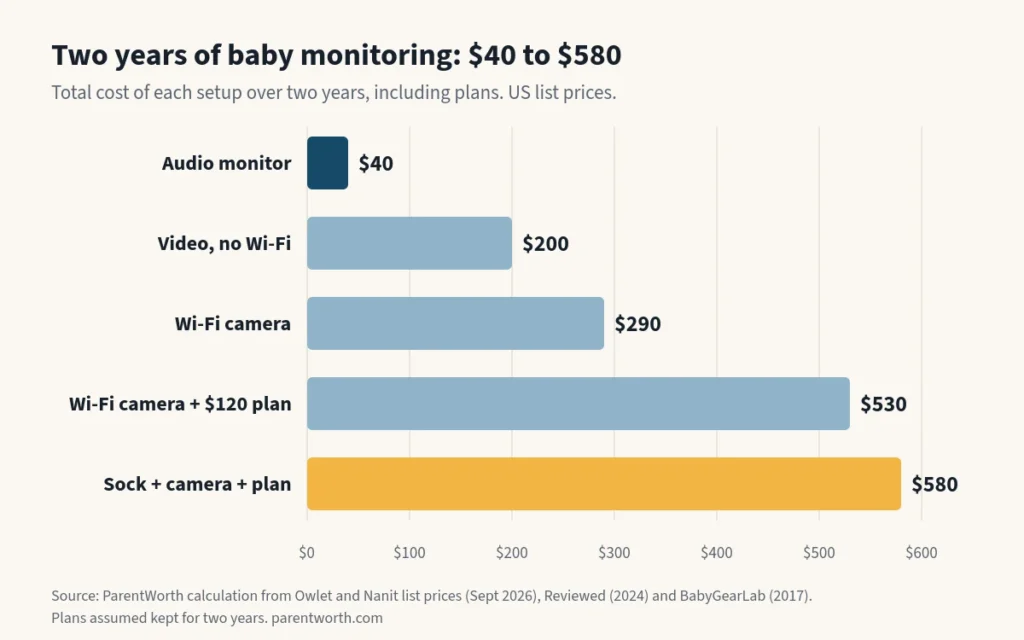
The most expensive setup costs more than 14 times as much as the cheapest. It’s the same question we asked about $1,000 strollers: what does the extra money buy that you’ll actually use? For perspective, monitors are one of the smaller first-year costs; feeding and diapers usually cost more.
Do smart monitors make babies safer?
Two different kinds of product get called baby monitors. One lets you see or hear your baby from another room. The other measures heart rate, breathing or oxygen. NIH’s Safe to Sleep campaign draws the same line, and on the second group it is clear: home heart, breathing and motion monitors are not recommended as a way to detect SIDS, and the American Academy of Pediatrics recommends that caregivers not use them to prevent SIDS.
The Owlet Dream Sock is the best-known product in that second group. In November 2023 the FDA authorized it as an over-the-counter device that shows pulse rate and oxygen readings and alerts caregivers, for babies 1 to 18 months old weighing 6 to 30 pounds. The same FDA letter says the sock is not intended to replace traditional methods of monitoring, diagnosis or treatment.
FDA authorization doesn’t make it a SIDS prevention device. What lowers risk is how your baby sleeps: on their back, on a firm mattress, with pillows, blankets and stuffed animals kept out of the crib, as the American Academy of Pediatrics advises parents.
This isn’t medical advice. If your baby was born early or has a health condition, your pediatrician may prescribe monitoring, and that is a different decision from the one this article covers.
Watch out: cords
Whatever you buy, keep the monitor and its cord at least 3 feet from the crib. By 2012 the Consumer Product Safety Commission knew of seven strangulation deaths involving baby monitor cords since 2002.
How long you’ll really use it
Safe-sleep guidance recommends that your baby sleeps in your room, in their own crib or bassinet, for at least the first six months. At night in those months, you are the monitor. A monitor earns its keep for naps, and once your baby moves to their own room.
That timing hits the vital-sign sock hardest. It’s authorized for babies up to 18 months, so if you start at one month you get about 17 months of intended use: roughly $17.65 a month for the $299.99 sock alone. A camera can stay in use as a room camera long after that.
If you’re thinking about moving partly to give your baby their own room, our bigger home after a baby breakdown covers that cost.
Wi-Fi cameras: convenience and security
The premium feature most parents actually use is watching from a phone: checking on a nap from the garden, or letting a second caregiver look in from work. A non-Wi-Fi monitor such as the Infant Optics DXR-8 PRO can’t do that; its picture only shows on its own parent screen.
The trade-off is that anything online needs looking after.
Tip: secure a Wi-Fi monitor
The Federal Trade Commission’s advice for home cameras: replace the default password with a strong one you don’t use anywhere else, install software updates, turn on encryption if the camera offers it, and switch on two-factor authentication for the app account.
Who should pay more, and who shouldn’t
Small home, baby in your room
You can hear the nursery from most rooms, and the baby sleeps next to you for the first six months.
Audio monitor: about $40
Two caregivers, bigger home
You split nap and night duty, or you’re often outside or in another part of the house.
Wi-Fi camera: $289.99, plus any plan
Buying for peace of mind about SIDS
The extra money doesn’t buy lower risk. Safe-sleep habits do.
Vital-sign sock: not worth it for this reason
Is it worth it?
Verdict: it depends
If the extra money is for safety, no. Official US guidance says monitors don’t prevent SIDS, and no product can. If it’s for a convenience you’ll use every day, such as phone viewing for two caregivers, a Wi-Fi camera can be worth its premium of about $250 over an audio monitor. A sock-and-camera setup at about $580 over two years is hard to justify on money alone.
Decision rules
- If your baby will sleep in your room and your home is small, start with a basic audio monitor and upgrade only if you find you need a picture.
- If two people share nap and night duty, or you’re often out of earshot, a Wi-Fi camera is the upgrade worth paying for.
- If you want video but nothing connected to the internet, choose a video monitor without Wi-Fi.
- If you’re considering a breathing or oxygen monitor to prevent SIDS, skip it, follow safe-sleep guidance, and talk to your pediatrician about any medical concern.
- If you buy a plan, set a reminder before it renews: these plans are billed a year at a time.
Budget pick: VTech DM221 audio monitor
Good for: the first rule above, when your baby sleeps close by and you only need to hear them wake. It’s the $40 audio example used in our cost tables. The listing describes a range of up to 1,000 feet, a vibrating sound alert, a talk-back intercom and a night light.
Frequently asked questions
Do breathing monitors prevent SIDS?
No. NIH’s Safe to Sleep campaign says no product can prevent SIDS and that heart, breathing and motion monitors are not recommended as a way to detect it. The American Academy of Pediatrics recommends that caregivers not use them to prevent SIDS.
Is the Owlet Dream Sock FDA approved?
The FDA authorized it in November 2023 through its De Novo process as an over-the-counter device that shows pulse rate and oxygen readings, for babies 1 to 18 months and 6 to 30 pounds. That authorization is not a finding that it prevents SIDS, and the FDA letter says it isn’t intended to replace traditional monitoring, diagnosis or treatment.
Do Nanit and Owlet charge subscriptions?
Both sell annual plans. Nanit’s Insights plans run from a Sleep Plan at under $10 a month after three free months to Memories at $120 a year and Milestones at $300 a year. The Owlet360 plan costs $99.99 a year. (List prices, September 2026.) Check what the device does without a plan before you buy.
How long do you need a baby monitor?
There’s no official answer. Safe-sleep guidance has your baby in your room for at least the first six months, so many families rely on a monitor mostly after that. The cost math above assumes two years of regular use.
Is a video monitor worth it over an audio one?
Only if you’ll use the picture. Audio tells you your baby is awake; video helps you decide whether to go in. At the prices above, moving from audio to a video monitor without Wi-Fi costs about $160 more.
Sources
- National Institutes of Health, Safe to Sleep. Frequently asked questions. Accessed September 2026.
- National Institutes of Health, Safe to Sleep. Ways to reduce baby’s risk. Accessed September 2026.
- HealthyChildren.org (American Academy of Pediatrics, with Consumer Reports). The truth about home apnea monitors for SIDS. Updated 2017.
- U.S. Food and Drug Administration. De Novo decision DEN220091: Dream Sock. November 8, 2023.
- U.S. Consumer Product Safety Commission. Baby monitor cords: 3 feet from baby. July 2012.
- Federal Trade Commission. How to secure your home security cameras. February 2023.
- Owlet. Dream Sock, Dream Duo (Gen 3) and Owlet360 Annual Plan product pages. Prices checked September 26, 2026.
- Nanit. Smart Baby Monitor System and Insights memberships. Prices checked September 26, 2026.
- Reviewed. Infant Optics DXR-8 PRO baby monitor review. January 2024.
- BabyGearLab. VTech DM221 review. June 2017.