Cloth diapers save money on paper—but factor in laundry, utilities, wear-and-tear, and your time, and the gap shrinks. We model the real 2.5-year cost.
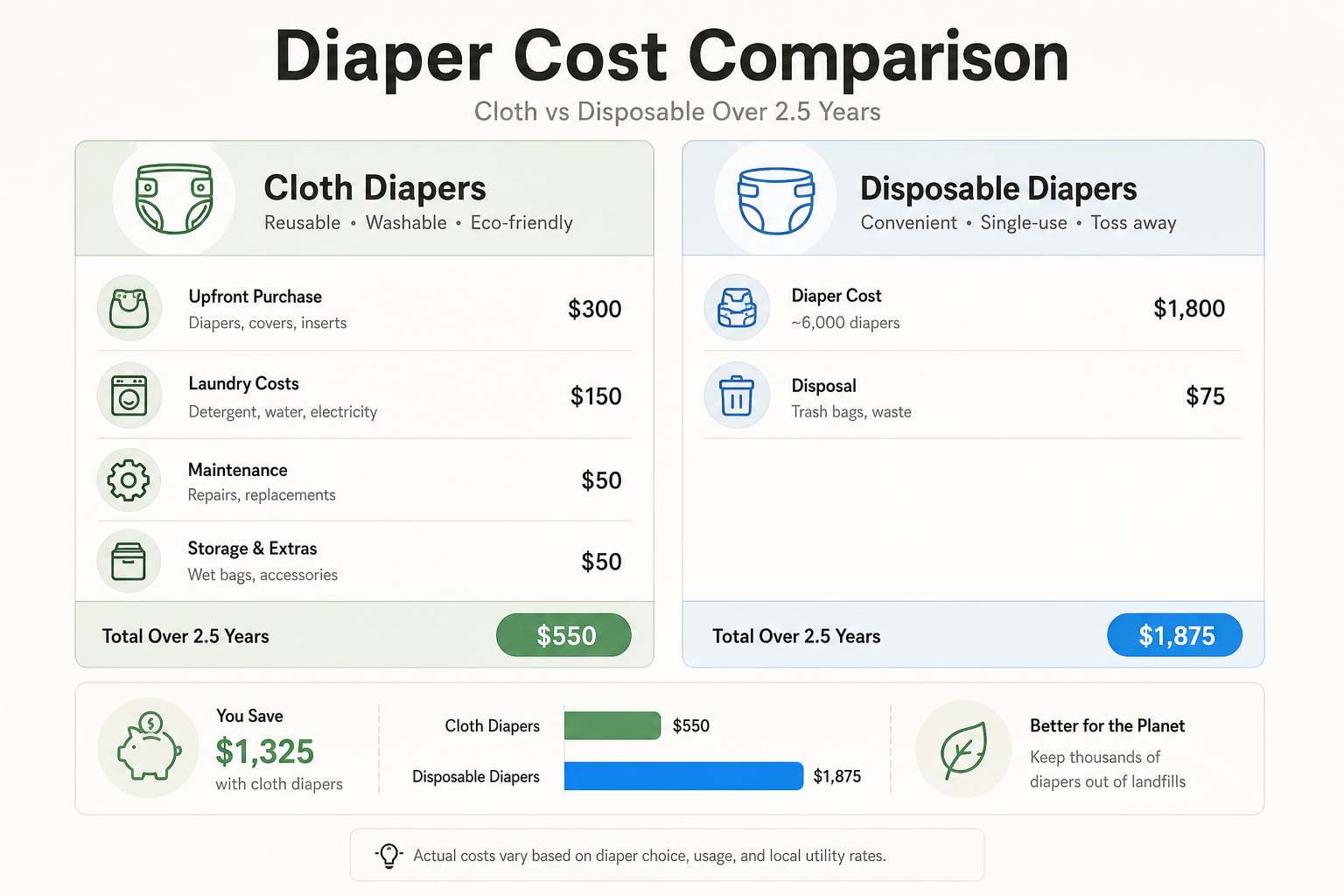
The cloth diaper debate sits at the intersection of parenting mythology, environmental guilt, and actual math.
The myth: Cloth diapers save you thousands of dollars.
The reality: Cloth diapers might save you $1,000 over 2.5 years if you do all the laundry yourself, don’t value your time, and never need to replace diapers due to wear.
Once you factor in utilities, laundry additives, replacement costs, and the time you spend managing wash cycles, the savings shrink. Once you add the option of a diaper service (which many families need because they can’t keep up with home washing), the savings nearly vanish.
Cloth diapers aren’t a bad choice. They’re just not the financial slam-dunk that parenting blogs suggest.
The cost comparison: Disposables vs. Cloth (home-washed)
Let’s model the real costs over 2.5 years (birth to potty training around age 2.5).
Disposable diapers: Premium brand (Pampers, Huggies)
Newborns use ~10-12 diapers per day. By month 6, it drops to ~8 per day. By year 2, it’s ~6 per day.
| Period | Diapers/Day | Cost/Unit | Monthly Cost | 6-Month Cost |
|---|---|---|---|---|
| Months 0-6 | 10 | $0.30 | $90 | $540 |
| Months 6-12 | 8 | $0.28 | $67 | $402 |
| Months 12-24 | 6 | $0.26 | $47 | $564 |
| Months 24-30 | 4 | $0.25 | $30 | $180 |
| Total 2.5 years | – | – | – | $1,686 |
Add wipes (~$0.02 per wipe, ~6 per day): +$270
Total disposable cost: $1,956 over 2.5 years
Cloth diapers: Home-washed
Upfront investment:
- 24 cloth diapers (all-in-one or pocket): $600-$900
- Diaper covers: $100-$200 (if using prefolds)
- Wet bag for storage: $30-$50
- Pail and liners: $40-$60
- Snappers, safety pins, extras: $50
- Total upfront: $820-$1,260
Ongoing costs (per 2.5 years):
- Laundry detergent specific to cloth: $20-$30/month = $600-$900
- Additional water and electricity: $30-$50/month = $900-$1,500
- Replacement diapers (wear and tear): $100-$200
- Diaper liners (flushable, not strictly necessary): $50-$100
- Total ongoing: $1,650-$2,700
Resale value (sell used cloth diapers):
- Used cloth diapers resell for 40-60% of original price
- 24 diapers at $25 each = $600. Resale at 50%: -$300
Total cloth diaper cost: $820 + $1,650 – $300 = $2,170 (low end) to $1,260 + $2,700 – $300 = $3,660 (high end)
The gap: It’s smaller than you think
| Method | Total Cost | Per-Diaper Cost |
|---|---|---|
| Disposables (premium) | $1,956 | $0.28 |
| Cloth (home-washed, low-end) | $2,170 | $0.31 |
| Cloth (home-washed, high-end) | $3,660 | $0.52 |
Depending on variables, disposables might actually be cheaper than cloth.
The break-even point? You only save money if you’re washing cloth diapers at minimal cost and reselling afterward.
The time cost: The hidden expense nobody discusses
Home washing cloth diapers requires:
- Rinsing immediately after use (5-10 min per diaper change): ~45 minutes/day
- Running 2-3 loads per week: 2-3 hours of active wash/dry time
- Folding and assembling: 30 minutes, 2-3 times per week
- Problem-solving (leaks, fit issues, stains): 10-20 hours total over 2.5 years
Total time: ~700-800 hours over 2.5 years
If you value your time at $15/hour (well below most professional wages): $10,500-$12,000 in time cost
If you value your time at $25/hour: $17,500-$20,000 in time cost
At any reasonable wage, the time cost dwarfs the money saved.
This is why many families switch to diaper services mid-way through: the time cost is unsustainable.
Diaper services: The middle ground
Diaper services (Diaper Plus, Nappy Ninja, similar services in your city) offer:
- You put dirty diapers in a bag
- Service picks up 1-2x per week
- Service delivers clean diapers
Cost: $70-$150 per week, depending on volume and your location.
| Calculation | Cost |
|---|---|
| Diaper service (average $100/week) | $5,200 over 2.5 years |
| Disposables | $1,956 over 2.5 years |
| Difference | -$3,244 (service costs more) |
Diaper services are not cheaper than disposables. They’re chosen for environmental reasons or convenience, not cost.
However, many families use a hybrid approach:
- Cloth at home (self-washed) for evening/weekend use
- Disposables for daycare/away-from-home
- This reduces cloth volume needed, lowers laundry frequency, and splits the cost
A hybrid might cost $1,300-$1,800 over 2.5 years-modestly cheaper than pure disposables, with lower time burden than pure cloth.
The variables that shift the math
The decision depends on:
When cloth wins:
- You’re having multiple children back-to-back (cloth amortizes over 4-5 kids)
- You value environmental impact and are willing to pay for it
- You genuinely enjoy laundry and don’t value your time at market rate
- You live in a place with cheap water and electricity (unlikely in most US metros)
- You’re using a low-cost hybrid approach (cloth + disposables)
When disposables win:
- This is your only child
- You have limited laundry facilities (apartment, no washer/dryer)
- Your time is valuable (you’re a working professional)
- You value convenience over cost savings
- You’re in a high-cost utility area
The environmental angle: More complex than the savings argument
Cloth diapers are sometimes better for the environment. Not always.
Cloth environmental cost:
- Water: 2,000+ gallons per child over 2.5 years
- Hot water heating (fuel cost)
- Detergent runoff
- Wear on fabrics requiring eventual landfill disposal
Disposable environmental cost:
- Landfill space (diapers take 450+ years to decompose)
- Manufacturing emissions
- Transportation and packaging
- Less water, less detergent, less hot water
If you’re washing cloth diapers in cold water, air-drying, and using eco-friendly detergent, cloth usually wins environmentally.
If you’re using hot water, frequent rewashing, and commercial detergent, the environmental advantage narrows significantly.
The real decision
Cloth diapers don’t save money. They might save money if you have multiple children and amortize the upfront cost across all of them, but for a single child with home-washed cloth, the math is barely in cloth’s favor, and that’s before you factor in your time.
Choose cloth if:
- You’re planning 2+ children and want to reduce per-child cost
- Environmental impact is genuinely important to you (and you commit to cold-wash, air-dry)
- You enjoy laundry-adjacent tasks (genuinely enjoy them)
- You’re using a hybrid approach
Choose disposables if:
- This is your first/only child
- Your time is limited or valuable
- You want simplicity
- You live in high-utility-cost areas
- You don’t have reliable laundry access
The parenting industry has sold cloth diapers as a financial win. They’re not. They’re a viable option with trade-offs, but “save thousands of dollars” isn’t one of them.
Use whatever works for your family’s lifestyle and values. Just don’t expect to bankroll college tuition with the savings.
Frequently Asked Questions
Do cloth diapers really save money?
If you do laundry yourself at home, cloth diapers save $800-$1,500 over 2.5 years compared to premium disposables. If you use a diaper service, the savings shrink to $200-$500. If you factor in your time at even $15/hour, the savings often disappear entirely.
What’s the upfront cost of starting cloth diapers?
A full cloth diaper setup (20-30 diapers, covers, liners, wetbag, pail, snappers) runs $800-$1,500. You need enough for 2-3 days of laundry without running out. Disposables have minimal upfront cost but high per-unit expense over time.
How much does laundry cost if you’re doing it at home?
Water and electricity for 2-3 cloth diaper loads per week: approximately $30-$50/month in utilities. Over 2.5 years, that’s $900-$1,500. Detergent-specific costs add another $200-$400. Diaper service laundry eliminates this but costs $70-$120/week.
Do cloth diapers last multiple children?
Yes. Well-made cloth diapers survive 2-3 children if stored properly and aren’t over-washed. Resale value is strong: you can recover 40-60% of your initial investment selling used cloth diapers. Disposables have zero resale value.
Which is better for the environment?
Cloth diapers have lower environmental impact if you wash in bulk with cold water and line-dry. But commercial laundry services (like diaper services) use hot water and energy, reducing the environmental advantage. Disposables end up in landfills but represent a smaller water/chemical footprint than home washing.