
After-School Activities: Which Ones Deliver the Best ‘Cost per Hour of Engagement’?
After-school activities range from $5 to $50 per hour. We break down the cost-per-hour for sports, music, tutoring, and online programs, plus the engagement ROI for each.
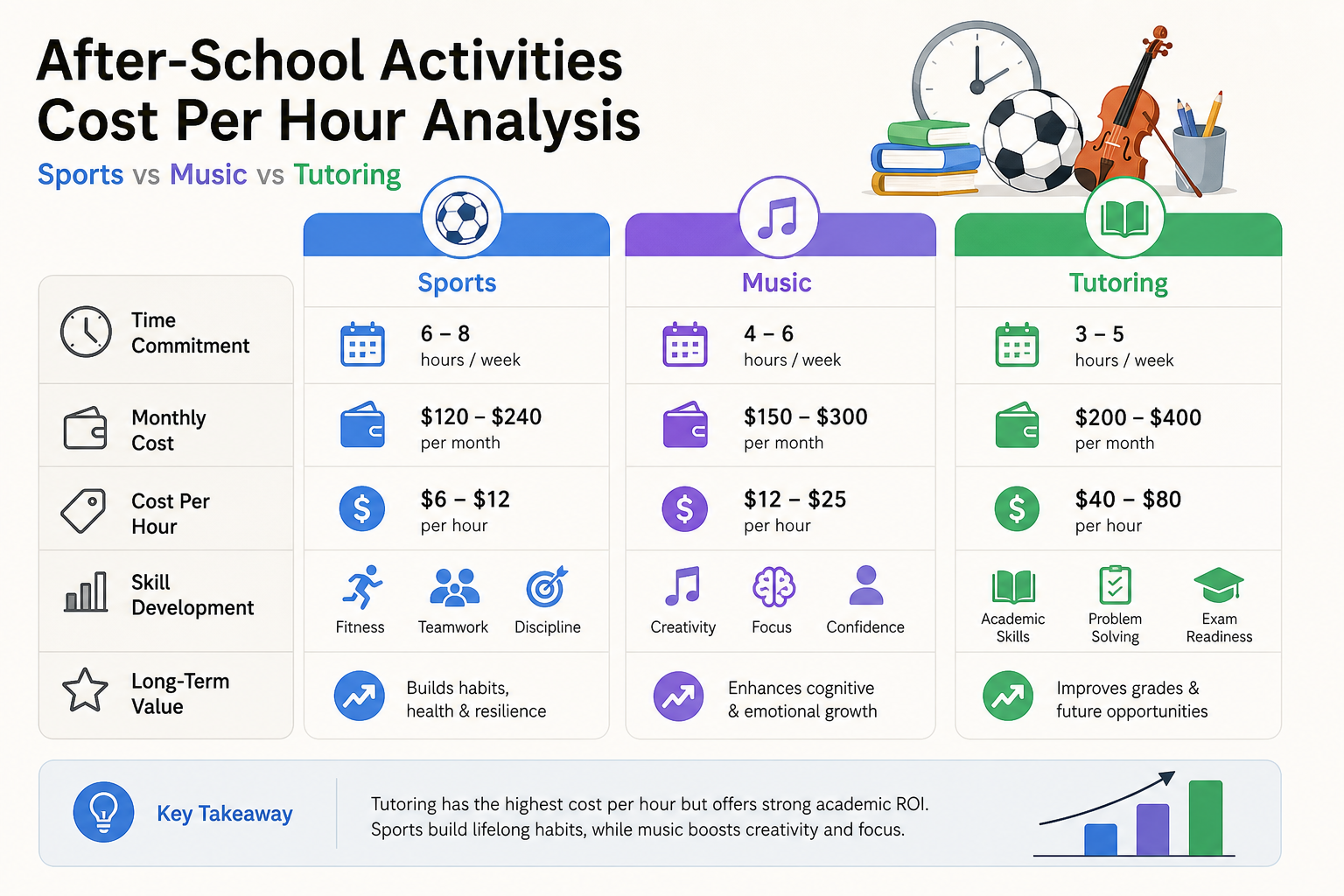
You’re looking at your 7-year-old and wondering what activity to sign up for. Soccer? Piano? Chess club? Coding camp?
The decision feels parental (enrichment, development, social skills). But the first thing you notice is cost. Soccer league is $150/season. Piano lessons are $30/week. Tutoring is $50/hour.
The real question isn’t “Which activity is best?” It’s “Which activity delivers value for the money?”
After-school activities range from $5 to $50 per hour of actual instruction. Knowing what you’re paying per hour-and for how long-changes which activity makes financial sense for your family.
The cost-per-hour breakdown
Sports (recreational league)
Cost example:
- Soccer fall league: $150 (8 weeks, 1 hour per week) = $18.75/hour
- Baseball spring league: $180 (10 weeks, 1.5 hours per week) = $12/hour
- Swimming lessons (group): $120 (8 weeks, 30 min per week) = $30/hour
The total includes league fees, equipment (partially), and coach time.
Engagement window: 8-16 weeks per season. A child might play the same sport for 5-10+ years, making annual cost more relevant than per-hour cost.
Per-year cost: $150-$400 for recreational; $500-$1,500 for competitive travel leagues.
Music lessons (private instruction)
Cost example:
- Piano or guitar (30 min/week): $30-$50/week = $60-$100/hour of instruction
- Same lesson (45 min/week): $45-$75/week = $60-$100/hour
- Group music class (1 hour/week): $20-$40/week = $20-$40/hour
Private music has the highest per-hour cost of all activities.
Engagement window: Highly variable. Kids who love it stick for years (age 6-18). Kids who don’t love it quit in weeks.
Per-year cost: $1,500-$2,400 for year-round private lessons.
Tutoring (academic help)
Cost example:
- Group tutoring (1 hour/week): $15-$25/week = $15-$25/hour
- Private tutoring (1 hour/week): $40-$60/week = $40-$60/hour
- Online tutoring (30 min/week): $20-$40/week = $40-$80/hour (only 30 min of actual instruction)
Tutoring is usually shorter-term (6-12 months) focused on a specific academic gap.
Engagement window: 6-12 months typically. Not a long-term activity.
Per-year cost: $800-$2,500 depending on intensity and whether it’s in-person or online.
Online/Screen-based programs
Cost example:
- Khan Academy Plus: $10-15/month = roughly $2.50-$4/hour (assuming 4-6 hours/month used)
- Coding programs (Code.org, Scratch): $5-20/month = varies widely based on time spent
- Online language lessons (Duolingo, Rosetta Stone for kids): $10-20/month
- YouTube + educational subscriptions: $5-15/month
The real cost-per-hour depends entirely on how much your child actually uses it. Many families pay for subscriptions no one uses.
Engagement window: Highly variable. Easy to start, easy to abandon.
Per-year cost: $60-$240 if actively used; $120-$240 if subscription but minimal use.
The engagement ROI question: Cost per hour of real engagement
Cost-per-hour doesn’t matter if your kid doesn’t actually engage.
A $60/hour piano lesson is a terrible deal if your child quits after 4 weeks. A $12/hour recreational soccer league is a great deal if your child plays every year for 5+ years.
| Activity | Cost/Hour | Typical Duration | Years Engaged (if goes well) | Engagement ROI |
|---|---|---|---|---|
| Recreational sports | $12-20/hour | 8 weeks-season | 3-10+ years | Excellent (if kid likes it) |
| Music lessons (private) | $60-100/hour | 1-2 years (median) | 2-15+ years | **Moderate-Excellent (high dropout) ** |
| Tutoring | $15-60/hour | 6-12 months | 0-2 years | Low (not ongoing, goal-based) |
| Group classes | $15-40/hour | 1 season | 1-3+ years | Moderate (less commitment than music/sport) |
| Online programs | $2-20/hour | Variable | 1-3 months (median) | Low (easy dropout, low engagement) |
The worst performers are online programs and tutoring: they have low per-hour costs but also the lowest engagement and shortest duration. You’re not saving money if nobody uses it.
The best performers are sports and music: higher cost-per-hour, but multi-year commitment if the kid is interested.
The hidden costs nobody mentions
The per-hour cost is just the starting line.
| Hidden Cost | Annual Impact |
|---|---|
| Parent transportation | $500-2,000 (time + gas + tolls) |
| Equipment (sports, music) | $100-$500 per activity |
| Uniforms/costumes (team sports, dance) | $50-$200 per season |
| Tournaments/recitals (optional upgrades) | $50-$500 per year |
| Backup lessons (catch-up if kid missed) | $50-$200 per year |
| Activity-specific meals/snacks | $200-$500 per year |
| Total hidden cost | $950-$4,000+ per activity |
A $150 soccer season that seemed cheap suddenly costs $500-$800 when you add transportation, equipment, snacks, and tournament options.
A $1,500/year music lesson that seemed expensive is $1,800-$2,200 when you add instrument rental/purchase, recital fees, and theory books.
The pick-one vs. pick-many decision
Can your family afford multiple activities?
| Cost Scenario | What Works |
|---|---|
| $100/month budget | One budget activity (rec sports) OR one shorter-term activity (seasonal tutoring) |
| $200-300/month budget | One deeper activity (music or competitive sport) + one exploration activity (group class) |
| $400+/month budget | Multiple activities, or one expensive activity (competitive sport/private music) |
Most families are in the $100-300/month range per kid. That’s roughly one meaningful activity.
Pushing kids toward multiple activities:
- Adds logistics burden (you’re constantly driving)
- Dilutes depth (they don’t get good at any one thing)
- Increases cost per unit of engagement
- Often results in kids enjoying none of them and you exhausted
The better model: One “deep” activity (music or sport) where they build skill and identity. One “exploration” activity (group class, club sport, seasonal program) for variety and social connection.
Making the choice: The real decision framework
Before signing up, answer these:
- Does my kid actually want to do this, or am I suggesting it? Kids driving their own activity choice → longer engagement. Parents driving it → higher dropout rate.
- Can I commit to transportation for a full season? If not, don’t start. Mid-season quitting costs money with zero engagement.
- What’s the true cost (per-hour + hidden)? If it’s more than $40/month total, does it fit the budget?
- How long is the commitment? Tutoring (6 months) = low obligation. Music (open-ended) = long obligation.
- Does this fit with other activities? Two activities max for most families. More than that, quality of engagement drops.
The cheapest activity ($5-10/month online program) often delivers zero value because nobody uses it. The most expensive activity ($100/month music lessons) delivers huge value if the kid is motivated.
Cost matters. But engagement matters more. Pay for what your kid will actually do, not what looks good on a resume.
Frequently Asked Questions
What’s the average cost per hour for kids’ activities?
Recreational sports: $10-15/hour. Competitive sports: $20-40/hour. Private music lessons: $25-60/hour. Group tutoring: $15-25/hour. Online programs: $5-20/hour. Most parents spend $100-$300/month per child on activities.
How long should a kid stick with an activity?
Most experts recommend giving an activity 3-6 months before quitting. This allows time for initial discomfort to pass and genuine interest (or lack thereof) to emerge. Activities that last 1-2 years show better skill development and confidence.
Which activities have the longest engagement window?
Music and sports have the longest multi-year engagement when kids enjoy them (ages 6-18+). Tutoring and academic enrichment are typically shorter-term (1-2 years) and tied to specific academic gaps. Online programs vary widely in engagement.
Do private lessons give better ROI than group classes?
Private lessons cost 2-3x more than group classes, but results come 2-3x faster for motivated students. For kids who are self-motivated, private lessons ROI is strong. For kids who need group energy and socialization, group classes are better value per dollar.
Is it better to pick one activity or encourage multiple?
One deep activity (music, competitive sport) builds skill and identity. Multiple activities build exploration and social connection but dilute depth. Most families do best with one ‘deep’ activity (music or sport) and one ‘exploration’ activity (art, coding, club sport).