Four plane tickets, or one tank of gas at a time. For a family of four that is the real choice. A common rule of thumb, and the one an earlier version of this article gave, says to drive anything under about 1,000 miles and fly the rest.
We tested that rule with 2026 numbers: the Department of Transportation’s average fares by distance, this fall’s gas price, AAA’s running costs for an SUV and the bag fees airlines charge today. On cash alone, driving won every trip we priced, up to 1,800 miles each way.
What a plane ticket buys is time, so we priced that too: how many travel days flying saves, and what each one costs. This is a money comparison. Which trip is easier or safer for your children is your call.
Why a family of four changes the math
A car costs about the same to run with one person in it or four. Airfare is charged per seat, and under federal aviation rules every passenger who has turned 2 needs one. Only a child under 2 may ride on a parent’s lap. Every extra child adds a full fare, one of the costs that grows with family size in our one child vs two children breakdown.
Fares also rise less with distance than most people expect. In the DOT fare data for the first quarter of 2026, the average one-way fare was $220.94 for trips under 300 miles and $249.89 for trips of 1,000 to 1,250 miles: $28.95 (13.1%) more for several times the distance. The cost of driving rises with every mile, but it starts from almost nothing.
| Nonstop distance | Average one-way fare | Round trip for four |
|---|---|---|
| Under 300 miles | $220.94 | $1,767.52 |
| 300 to 500 miles | $226.89 | $1,815.12 |
| 500 to 750 miles | $238.62 | $1,908.96 |
| 750 to 1,000 miles | $235.64 | $1,885.12 |
| 1,000 to 1,250 miles | $249.89 | $1,999.12 |
| 1,250 to 1,500 miles | $283.92 | $2,271.36 |
| 1,500 to 2,000 miles | $323.51 | $2,588.08 |
| 2,000 to 3,000 miles | $377.47 | $3,019.76 |
DOT counts one-way passenger trips, so we double its fares for a round trip. That gives $453.78 to $499.78 per person for trips of 300 to 1,250 miles, close to the $445.26 average domestic ticket that the Bureau of Transportation Statistics reported for the second quarter of 2026. The BTS figure mixes round-trip and one-way tickets, includes taxes and leaves out bag fees.
The assumptions
Assumptions
- Two adults and two children aged 2 or older, so four airline seats. One week away.
- Five vacations at 400, 600, 900, 1,200 and 1,800 miles each way, each priced both ways.
- Driving: an SUV at 25.7 mpg, the EPA real-world average for model-year 2024 truck SUVs. Regular gas at $4.269 a gallon, the EIA U.S. average for the week of October 26, 2026. Maintenance at 12.16 cents a mile, the AAA 2026 figure for a medium SUV.
- At most 500 miles of driving a day. Each overnight stop costs $113, the federal standard lodging rate for fiscal 2027, used here as the price of a budget roadside room.
- Flying: the DOT average fare for the distance, doubled for the round trip. Two checked bags each way at the $45 first-bag fee Delta and Alaska charge. Seven days of parking at $16 a day, the drive-up rate at the Remote lot at DFW Airport. A rental car at $82.90 a day, the average in a summer 2026 survey of 100 airports by the booking site CheapCarRental.com.
- Left out because they cost the same either way: lodging and food at the destination, and meals on travel days. Also left out: tolls, airport food, seat fees and rides to the airport.
The cost of one trip at five distances
| Distance each way | Drive | Fly, no rental car | Fly and rent a car |
|---|---|---|---|
| 400 miles (1 day each way by car) | $230 | $2,107 | $2,687 |
| 600 miles (2 days) | $571 | $2,201 | $2,781 |
| 900 miles (2 days) | $744 | $2,177 | $2,757 |
| 1,200 miles (3 days) | $1,143 | $2,291 | $2,871 |
| 1,800 miles (4 days) | $1,714 | $2,880 | $3,460 |
| All five vacations | $4,402 | $11,656 | $14,558 |
The drive is cheapest at every distance, and the gap is widest on short trips, where the four fares are almost as high as on long ones. Flying 400 miles and renting a car costs about 12 times as much as driving it. By 1,800 miles, with six nights in roadside hotels, the drive still costs half as much as flying and renting a car.
The 1,200-mile trip, line by line
| Cost | Drive | Fly |
|---|---|---|
| Gas: 2,400 miles ÷ 25.7 mpg × $4.269 | $398.66 | $0 |
| Maintenance: 2,400 miles × 12.16¢ | $291.84 | $0 |
| Hotels on the road: 4 nights × $113 | $452.00 | $0 |
| Tickets: 8 one-way fares × $249.89 | $0 | $1,999.12 |
| Checked bags: 4 × $45 | $0 | $180.00 |
| Airport parking: 7 days × $16 | $0 | $112.00 |
| Rental car: 7 days × $82.90 | $0 | $580.30 |
| Total | $1,142.50 | $2,871.42 |
$1,729
How much more it costs a family of four to fly 1,200 miles each way and rent a car for the week than to drive, even after paying for four nights in hotels on the road.
Source: ParentWorth calculation from DOT Q1 2026 fares, the EIA gas price for October 26, 2026, AAA, GSA and airline bag fees.
Five vacations, same five trips
Over the five vacations, driving costs $4,402. Flying the same trips costs $14,558 with a rental car each time, or $11,656 if someone at the other end lends you a car. That is $10,156 or $7,255 more.
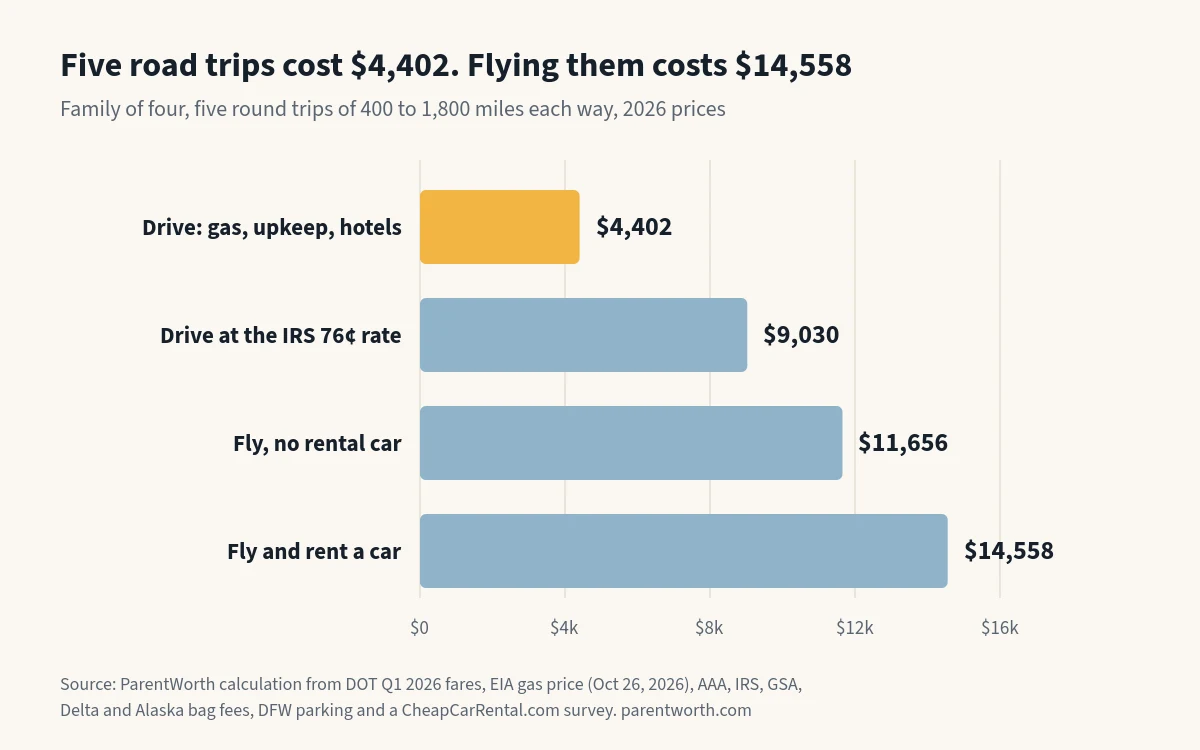
Mixing the two only saves money when each mode wins some trips. At these prices driving wins all five, so the cheapest mix is to drive every time. The real trade is the one in the next sections: money against days.
Costs people forget
Watch out
The rental car is the biggest add-on to flying. At $82.90 a day it adds $580.30 to a week away, more than the bags and parking together ($292). The survey priced the cheapest car available at each airport and doesn’t say whether taxes and fees are included.
Delta charges $45 for the first checked bag and $55 for the second, each way, and Alaska charges the same for tickets bought from April 10, 2026. Two bags in each direction, one per adult, add $180 to a round trip. Delta checks strollers and child car seats free, so you can bring your own seats for the rental car rather than rent them. If you’re still choosing seats, we priced what a $500 car seat buys and when an infant carrier is worth it.
The drive has costs we left out too, such as tolls and hotel parking. Add them for your route: on the 1,200-mile trip they would have to reach $1,729 to close the gap.
What if you count the whole cost of the car?
Gas and maintenance are the costs that rise with each mile. The IRS business mileage rate of 76 cents a mile for the second half of 2026 also covers insurance, registration and depreciation. Most of those you pay whether you take the trip or not, so the IRS rate overstates what one more vacation costs. It is still a useful worst case.
At 76 cents a mile, the five road trips cost $9,030: still less than flying them. Trip by trip, flying becomes cheaper from about 1,210 miles each way if you don’t need a rental car, and from about 1,840 miles if you do.
A middle measure is the extra depreciation from driving more. AAA’s 2026 figures put it at $484 a year for a medium SUV driven 20,000 miles instead of 15,000, or 9.68 cents a mile. Adding it raises the 1,200-mile drive to $1,374.82. With that cost included, flying wins only beyond 2,840 miles each way without a rental car, and never with one in this fare data.
What flying actually buys: days
We count one travel day each way for flying and up to 500 miles a day for driving. At 400 miles both take a day, so flying saves no time and costs $2,457 more. From 600 miles on, flying saves days, and you can price each one.
Grandparents 600 miles away
Two days each way by car, one by plane. Family can lend you a car there.
Drive for $571 or fly for $2,201: $815 for each day saved.
Beach week 1,200 miles away
Three days each way by car. You need a car at the beach.
Drive for $1,143 or fly for $2,871: $432 for each day saved.
Cross-country, 1,800 miles
Four days each way and six hotel nights on the road. Rental car needed.
Drive for $1,714 or fly for $3,460: $291 for each day saved.
The longer the trip, the cheaper each saved day becomes, because the drive adds hotel nights while the fares rise slowly. If a vacation day is worth more to you than about $300, flying a cross-country trip is a fair price for it. On a 600-mile visit, each day you save by flying costs over $800.
When flying can win on cash
Flying beats driving when the fares are low enough. For four people, the one-way fare per seat would have to fall below these levels:
| Trip, each way | Average fare (Q1 2026) | Break-even, no rental car | Break-even with a rental car |
|---|---|---|---|
| 1,200 miles | $249.89 | $106.31 | $33.78 |
| 1,800 miles | $323.51 | $177.72 | $105.18 |
Summer helps a little. In the third quarter of 2025, the average fare for 1,000 to 1,250 miles was $211.03, which brings the 1,200-mile flight with a rental car down to $2,560.54. That is still more than twice the drive. A child under 2 flying on a lap removes one seat: $499.78 off the 1,200-mile trip, leaving $2,371.64 with a rental car against $1,142.50 to drive.
Gas prices barely move the answer. At the EIA’s October 26 average for the West Coast, $5.417 a gallon, the 1,200-mile drive costs $1,249.71. At the Gulf Coast average of $3.702, it costs $1,089.55.
Make the road trip cheaper still
Tip
We counted meals as the same either way, but a car lets you bring food a plane won’t. Pack lunches for the travel days and groceries for the week, the same trade-off we priced in our packed lunch vs school lunch comparison.
Pick for the road trip: Coleman Classic Series 62-quart wheeled cooler

Good for: a family that drives and wants to carry a week’s food in the trunk. The listing says it keeps ice for up to 5 days in temperatures as high as 90°F, holds up to 101 cans without ice or 50 cans with 26 lbs of ice, and rolls on six-inch wheels. A cooler you already own does the same job.
Is it worth it?
Verdict: it depends
On cash, driving wins for a family of four at every distance we priced, from 400 to 1,800 miles each way. At 1,200 miles the drive costs $1,142.50, including four hotel nights, against $2,871.42 to fly and rent a car.
Flying is worth paying for when the days you would spend on the road matter more to you than the money: about $190 to $1,100 for each day saved, depending on the distance and whether you need a rental car. It also wins on cash if you count your car’s full IRS cost on long trips, or find fares far below average.
Decision rules
- If the trip is under about 500 miles each way, drive. Flying saves no days and costs $1,877 to $2,457 more at 400 miles.
- If you would need a rental car at the destination, add $580 a week to the flying cost before you compare.
- If you find one-way fares below about $106 per seat for a 1,200-mile trip and need no rental car, fly. Above that, driving is cheaper.
- If the drive takes three days or more each way, fly when a day off the road is worth more to you than flying costs per day saved: about $430 at 1,200 miles and $290 at 1,800 miles, with a rental car.
- If you want a worst case for the car, price the drive at the IRS rate of 76 cents a mile. Flying then wins only beyond about 1,210 miles each way without a rental car.
- If you drive, pack food for the road and count tolls on your route.
Frequently asked questions
Is it cheaper to fly or drive for a family of 4?
Driving, at average 2026 prices. A 1,200-mile trip each way costs $1,142.50 to drive, including gas, maintenance and four hotel nights, and $2,871.42 to fly with bags, airport parking and a rental car. Without a rental car the flight still costs $2,291.
At what distance does flying become cheaper than driving?
Within the lower 48, not at average fares if you count gas, maintenance and hotels. If you count your car’s full cost at the IRS rate of 76 cents a mile, flying becomes cheaper from about 1,210 miles each way without a rental car and 1,840 miles with one.
Do kids need their own seat on a plane?
Yes, from their second birthday. Federal rules require a seat for every passenger who has reached age 2; a child under 2 may ride on an adult’s lap. That is why a family of four usually pays four fares.
How much are checked bag fees for a family in 2026?
Delta and Alaska charge $45 for the first checked bag and $55 for the second, each way, on flights within the United States. If each adult checks one bag, that is $180 for a round trip. Delta checks strollers and car seats free.
Should I use the IRS mileage rate as the cost of a road trip?
Only as a worst case. The 76-cent rate includes insurance, registration and depreciation that you pay whether you travel or not. Gas plus maintenance, about 29 cents a mile in our SUV example, is closer to what one more trip costs.
Sources
- U.S. Department of Transportation. Consumer Airfare Report: Table 6, Contiguous State City-Pair Markets. Q1 2026 data, updated September 3, 2026.
- Bureau of Transportation Statistics. Average Domestic Airline Itinerary Fares. Q2 2026. Accessed November 2026.
- U.S. Energy Information Administration. Gasoline and Diesel Fuel Update. October 27, 2026.
- U.S. Environmental Protection Agency. Highlights of the Automotive Trends Report. February 19, 2026.
- AAA. Your Driving Costs 2026. September 15, 2026.
- Internal Revenue Service. Standard mileage rates. Accessed November 2026.
- U.S. General Services Administration. FY 2027 per diem highlights. 2026.
- Delta Air Lines. Baggage and travel fees. Accessed November 2026.
- Delta Air Lines. Special items: children and infant items. Accessed November 2026.
- Alaska Airlines. Checked baggage fees and policies. Accessed November 2026.
- National Archives, eCFR. 14 CFR 121.311, Seats, safety belts, and shoulder harnesses. Up to date as of October 29, 2026.
- Dallas Fort Worth International Airport. Remote parking. Accessed November 2026.
- CheapCarRental.com via EIN Presswire. Summer 2026 airport car rental price survey. June 11, 2026.