
One parent staying home doesn’t save money like you’d think. We model the 5-year impact: lost salary, career progression, childcare savings, and net worth difference.
May 20, 2026 · 12 min read
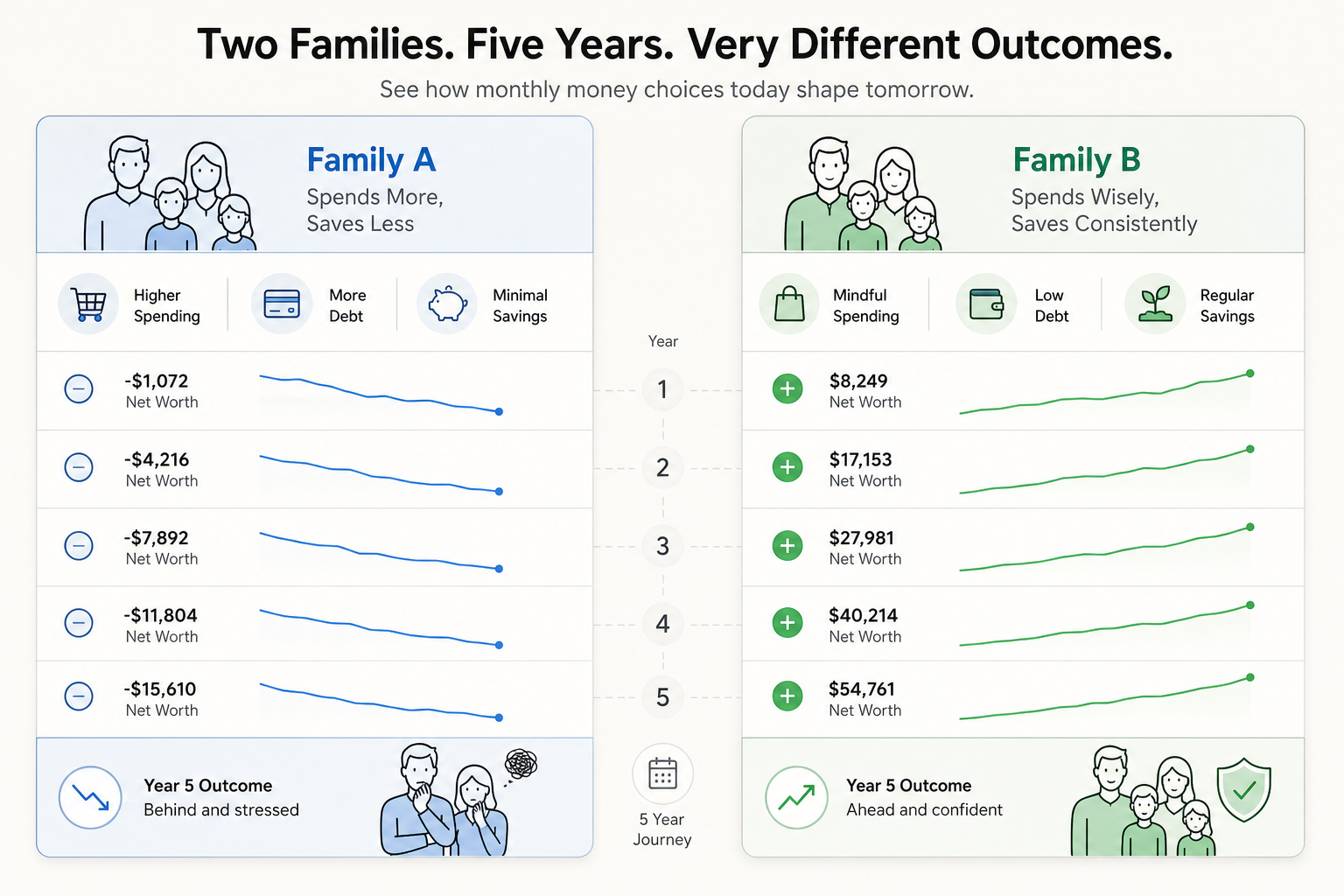
The decision to have one parent stay home feels urgent when you’re holding a newborn and looking at childcare quotes. Daycare is $1,200-$2,500 per month. Preschool is $1,000-$1,800. A nanny is $3,000-$6,000. The math feels obvious: pull one parent out, save $12,000-$30,000 per year.
But that math is incomplete. It captures the childcare savings, not the full picture.
Over 5 years, a parent stepping away from a solid income doesn’t break even. The lost salary, derailed career trajectory, and missed promotions create a financial gravity well that childcare savings alone cannot fill.
This isn’t a judgment. Plenty of families should have a stay-at-home parent. But if the decision is financial-if you’re trying to save money-it usually fails.
The 5-year cost: Salary lost, career stalled
Let’s model what actually happens when one parent steps out for 5 years.
Scenario: Parent A earns $70K, Parent B earns $55K
This is a solid dual-income family. Combined household income is $125K. Call them the Johnsons.
If Parent A (the $70K earner) leaves the workforce to stay home:
| Financial Component | Amount |
|---|---|
| Direct income loss | $350,000 |
| Payroll taxes saved (7.65% employer match + 7.65% employee) | ~$26,000 |
| Childcare costs saved annually | $18,000 (for 2 kids) |
| Total childcare saved over 5 years | $90,000 |
| Net income loss | $234,000 |
That’s already underwater before we factor in career progression.
Add career progression and promotions
Most careers don’t stay flat. Over 5 years, a stable employee earning $70K can expect:
- 3% annual salary increase (modest): reaches $81K by year 5
- One promotion or title bump (~5% bump): that’s another $15K-$20K in additional earnings
The pathway: $70K → $72K → $75K → $77K → $80K → $84K
When you step out of the workforce, you lose not just the raises but also the seniority and positioning for future roles.
Returning 5 years later? You re-enter the job market at a significant disadvantage.
- You’ve missed 5 years of industry changes, tool updates, software migrations.
- Your resume has a gap that employers scrutinize.
- Your “last salary” for negotiation purposes is now $70K (from 5 years ago), not $84K.
- Many employers have moved away from salary history questions, but the gap itself signals underutilization.
Real impact: Re-entering at 70-80% of where your peers advanced. If your cohort is at $90K+ in their new roles, you’re negotiating for $75K. Over the next 10 years, that compounds into $150K-$200K+ in lost lifetime earnings.
The career penalty is larger than the childcare savings
| Scenario | 5-Year Cost |
|---|---|
| Direct salary loss (no raises, no promotion) | -$234,000 |
| Lost career progression (reduced re-entry salary) | -$80,000-$150,000 |
| Total 5-year financial damage | $314,000-$384,000 |
| Childcare cost savings | $90,000 |
| Net loss | $224,000-$294,000 |
And this is before we account for:
- Reduced Social Security credits (each year outside the workforce is a zero-income year in your benefit calculation)
- Lost employer 401(k) contributions
- Lost employer health insurance cost sharing
- The “second-income penalty”: many services and benefits are means-tested in favor of single-income households, but that’s a minority case
When the math works: The childcare inflection point
For some families, one parent staying home is the financial winner. It’s just less common than it feels when you’re looking at infant care quotes.
The inflection point arrives when:
- Childcare costs exceed the secondary earner’s net income, AND
- The secondary earner has limited career growth, AND
- The family can live on the primary earner’s income without stress
Let’s model this:
Scenario: Parent A earns $95K, Parent B earns $38K
Parent B’s gross: $38K. After taxes (estimated 22% effective): $29,600/year, or $2,467/month.
Childcare for 2 kids: $2,200/month.
Parent B is netting $267 per month for working. In this case, one parent should stay home. The economics are clear.
But this is a specific family profile: high-earning primary earner, low-earning secondary earner, multiple kids in expensive care. For the dual-income median (both earners in the $50K-$80K range), one parent leaving the workforce usually creates a financial loss, not a gain.
Tax benefits: A partial offset, not a solution
Single-income families do receive some tax breaks.
- Standard deduction: Single-income filers get a slightly higher effective deduction relative to income.
- Child and Dependent Care Credit: Up to $3,000 in care costs (or $6,000 for 2+ kids) can be credited at 20-35% depending on income. For a family paying $20K in childcare, this might save $4,000-$6,000 per year in taxes.
- Dependent exemptions and credits: Some tax benefits are enhanced for single-income filers.
Total tax benefit for single-income households: roughly 10-20% of lost income for typical earners. It’s real, but it doesn’t bridge the gap.
The Social Security penalty: Long-term compounding
Here’s a cost that doesn’t show up in the 5-year model but destroys the math over a lifetime.
Social Security benefits are calculated based on your highest 35 years of earnings. Each year you don’t work is a year of $0 income included in that calculation.
A parent who:
- Earns $70K/year for 15 years (ages 25-40)
- Takes 5 years off (ages 40-45)
- Returns to earn $75K/year for 20 years (ages 45-65)
…has 5 zero-income years factored into their benefits calculation. Those zeros drag down the lifetime average.
Impact: Reduced Social Security benefits by approximately $2,000-$4,000 per year in retirement (for a 65-year-old receiving $2,500-$3,000/month, that’s a 15-20% penalty).
Over a 25-year retirement, that’s $50,000-$100,000 in lost lifetime benefits.
The real decision factors
If the financial math doesn’t work for most families, why do some still choose single-income arrangements? Because “financial” is only one input.
Valid reasons to have one parent stay home, despite the financial cost:
- Parenting philosophy: You believe hands-on early parenting is non-negotiable and worth the cost.
- Specific childcare gaps: You can’t find quality care for the hours/structure you need.
- Parental mental health: The working parent is in a role they hate; the staying-home parent wants the role.
- Second child planning: If you’re planning to have 3+ kids in quick succession, the career penalty for the second pregnancy may make single-income optimal.
- Partner’s income stability: If one partner has rock-solid income and benefits, the other can afford to step back.
These are legitimate. But “We can save money” usually isn’t true.
Making the decision: What actually matters
If you’re considering one parent stepping out, run the math for your specific situation. The averages don’t apply to everyone.
Key questions:
- What is the secondary earner actually netting after taxes and childcare? If it’s less than $400/month, single-income starts looking reasonable.
- How easily can the secondary earner re-enter their field? Tech workers re-enter easier than medical professionals or corporate management.
- Can you live on one salary + modest savings draw? This is the critical gate. If you can’t, single-income isn’t sustainable.
- What’s the primary earner’s job security and income trajectory? If it’s shaky, dual income is insurance.
The hardest part isn’t the math. It’s that taking time out of the workforce feels necessary when you’re in the thick of early parenting. Infantcare costs more than a nice car payment. Preschool tuition rivals college. The numbers are visceral.
But they’re also misleading.
The cost of one parent stepping out isn’t just the difference between one income and two. It’s the lost trajectory of the person who steps out, compounded over a lifetime. That cost usually exceeds the childcare savings by a wide margin.
If you’re going to do it, do it for reasons other than money. The money almost never wins.
Frequently Asked Questions
Does staying home with kids actually save money?
Not always. You save on childcare, but lose earning power, career progression, and Social Security credits. For a single parent earning $60K+, the net loss over 5 years usually exceeds childcare savings.
What’s the biggest financial cost of taking time out of work?
Opportunity cost: missed salary raises, promotions, and seniority. A parent earning $70K who takes 5 years off loses not just $350K in gross salary, but also 5+ years of 3% annual raises and potential promotions worth hundreds of thousands more.
Are there any tax advantages to one parent staying home?
Yes. Single-income families pay less in payroll taxes, have better access to dependent care credits, and may qualify for higher child tax credits. This can offset 10-20% of the gross income loss, but rarely covers the full gap.
How much does the staying-home parent miss in Social Security?
Each year out of the workforce counts as a zero-income year in Social Security calculations. Opting out of 5 years of work can reduce retirement benefits by $2,000-$5,000+ per year, depending on your earning history.
Is there a break-even point where one parent should stay home?
Yes: when childcare costs exceed the working parent’s net income. If you’re a single parent earning $40K gross, after taxes you might net $2,400/month, but childcare costs $1,800/month. The math shifts at that point, but the career penalty still applies.