
Skipping daycare to WFH with your kids sounds like it saves money. It often doesn’t. Here’s the real cost breakdown – including the career math most parents ignore.

For a lot of parents, the math looks obvious at first: daycare costs $1,500 a month, you work from home, why not just keep the kids with you and pocket the savings? It’s a reasonable question. The answer, though, is less about what daycare costs and more about what working from home with a toddler actually does to your income.
This isn’t a case where one option clearly wins. It depends on what you earn, where you live, how flexible your job is, and how honestly you assess what “WFH with kids present” looks like in practice. But most parents who run the full calculation – including the parts that don’t show up in monthly expenses – find the math is not what they expected.
What “working from home with kids” actually looks like
Before getting into dollar amounts, it’s worth being precise about what this option involves. “Working from home” typically means maintaining a full-time job with full-time productivity expectations, just from a home office. “With kids” means a child under 5 is in the same space, unsupervised by anyone else.
The Stanford WFH research project, which analyzed more than 60,000 workers, found that fully remote workers average about 10% lower productivity than in-person counterparts. That’s the baseline – before you add a toddler to the picture.
Parents who have actually tried it describe what happens:
“WFH with a baby is hard. WFH with a toddler is impossible. Only way it sort of works is if you can slack off on the work side.” — r/workingmoms
“I WFH and same situation. My toddler was home this week and I literally got nothing done. It was INSANE.” — r/toddlers
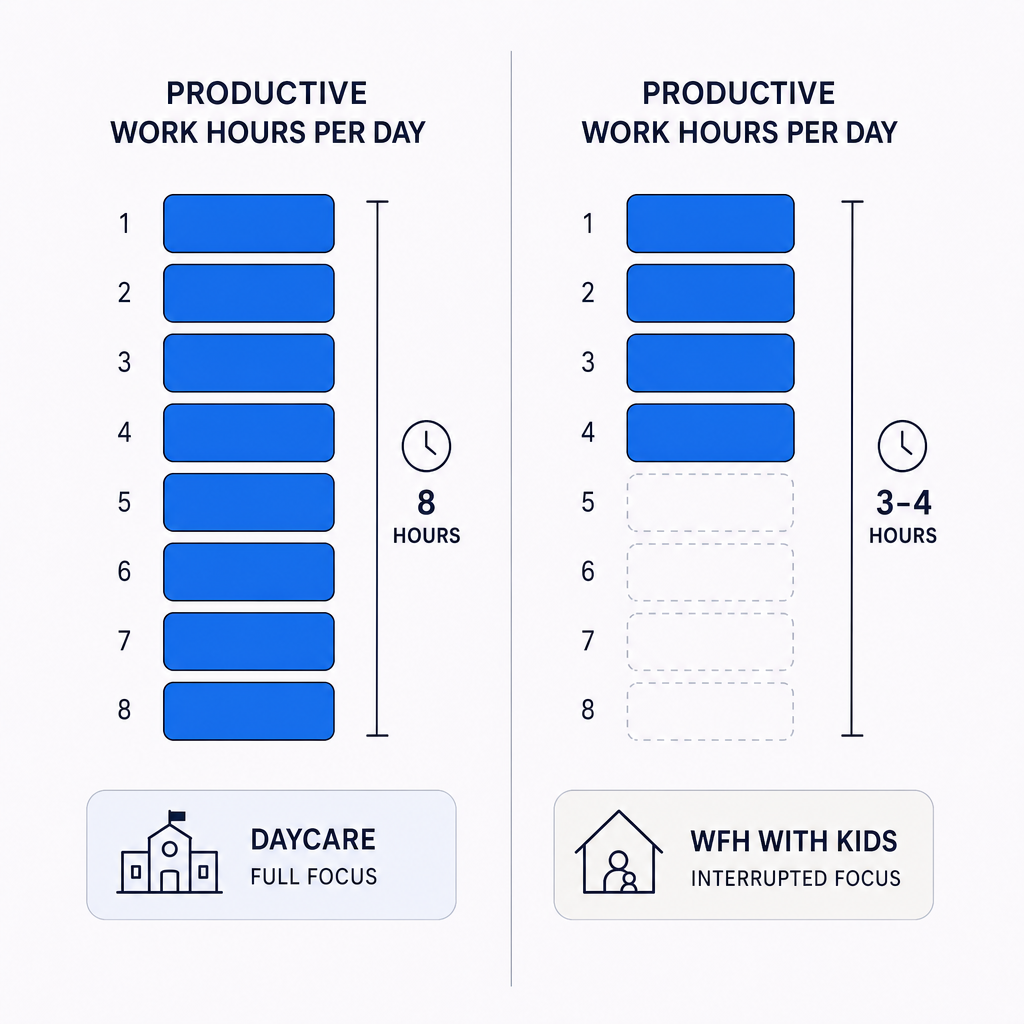
The honest reality: most parents with children under 5 at home report around 3-4 focused work hours per day, not the 7-8 an employer is paying for. The rest gets filled in early mornings, nap windows that don’t cooperate, and late nights.
What daycare actually costs in 2026
Daycare costs vary more than almost any other household expense. The Department of Labor’s National Database of Childcare Prices puts the national average for center-based infant care at $1,230 per month. In practice, the range is extreme.
National averages by age
| Age group | Weekly cost | Monthly cost | Annual cost |
|---|---|---|---|
| Infant (0-12 months) | $390-$450 | $1,560-$1,800 | $18,720-$21,600 |
| Toddler (1-3 years) | $340-$400 | $1,360-$1,600 | $16,320-$19,200 |
| Preschool (3-5 years) | $280-$340 | $1,120-$1,360 | $13,440-$16,320 |
These are center-based averages. Home-based family childcare runs 30-40% less, typically $900-$1,400 per month – a meaningful difference for families who qualify for good options nearby.
Where you live changes everything
The state-by-state variation is staggering. Annual infant care costs in 2026:
| State | Annual infant care | Monthly |
|---|---|---|
| Washington, D.C. | $28,356 | $2,363 |
| Massachusetts | $26,709 | $2,226 |
| Minnesota | $22,569 | $1,881 |
| California | $21,945 | $1,829 |
| Colorado | $21,840 | $1,820 |
| Texas | $10,706 | $892 |
| Alabama | $7,871 | $656 |
| Mississippi | $6,868 | $572 |
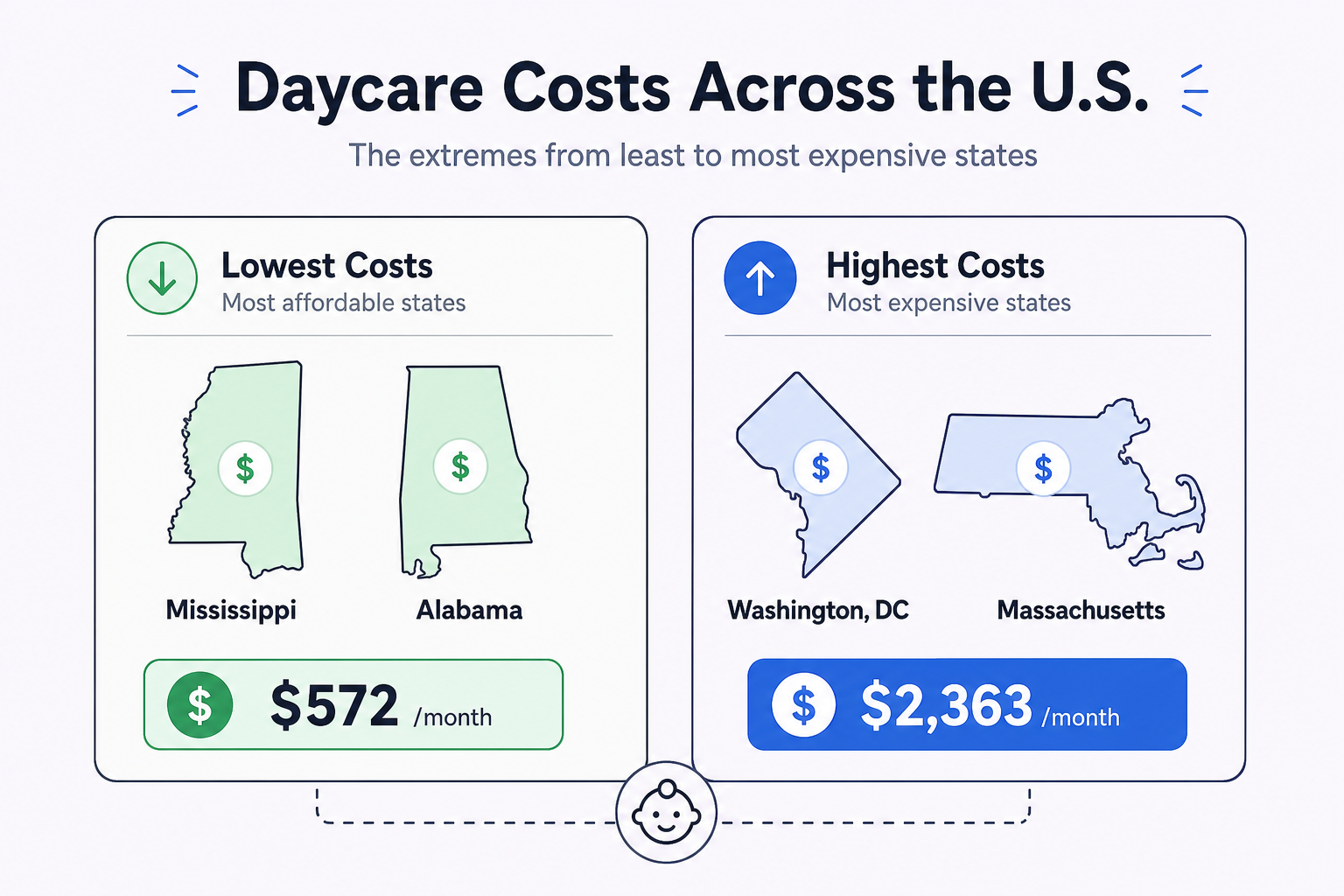
The federal definition of “affordable” childcare is 7% or less of annual household income. In Massachusetts, infant care consumes 18.1% of median family income. In Minnesota, 18.8%. For a single parent near minimum wage in Washington, D.C., that same care runs close to 78% of annual income.
Hidden daycare costs that get missed
Beyond monthly tuition, expect:
- Registration/enrollment: $50-$300 one-time
- Late pickup fees: $1-$5 per minute (adds up fast if your commute is unpredictable)
- Sick exclusion days: When your child has a fever and can’t attend, you pay full tuition and still need coverage
- Holiday closures: Most centers close for professional development days while still charging full rates
- Supplies and meals: Many centers charge separately for diapers, wipes, and food
A realistic total adds $1,500-$2,500 per year per child on top of stated tuition.
The net income math
The question that actually matters isn’t “what does daycare cost?” – it’s “what does your income look like with and without it?”
Here’s a realistic scenario for a parent earning $60,000 per year:
| In-office + full daycare | WFH + no daycare | |
|---|---|---|
| Gross income | $60,000 | $60,000 |
| Daycare cost | -$15,570 | $0 |
| Commute/work costs | -$3,000 | -$800 (home office) |
| Effective hours worked | 8 hrs/day | ~3-4 hrs/day |
| Productivity adjustment | Full salary | -10-20% effective output |
| Adjusted income value | $60,000 | ~$48,000-$54,000 |
| Net after childcare/costs | ~$41,430 | ~$47,200-$53,200 |
On this surface calculation, WFH without daycare comes out ahead by $6,000-$12,000 per year. That’s the number that tempts people.
What it doesn’t capture is the compounding career math.
The career cost most parents don’t calculate
U.S. Census Bureau research (2025) on maternal employment shows each year working at reduced capacity or outside normal advancement tracks carries roughly a 5% wage penalty. These penalties compound.
A parent who spends three years working at reduced effectiveness while managing childcare without support may find their wage baseline permanently lower. Missed promotions, fewer high-visibility projects, and reduced professional networking compound into something that doesn’t look dramatic in year one but matters enormously by year five.
For the $60,000 earner in the example above:
- 3 years of career stagnation due to WFH with kids: new baseline $51,000 (-15%)
- 5 years: new baseline $45,000 (-25%)
- These penalties don’t automatically reverse when the kids start school
The Annie E. Casey Foundation estimates that childcare challenges cost the American economy $122 billion per year in lost earnings and productivity – most of it concentrated in years when parents of young children try to work without adequate support.
The Quebec natural experiment is instructive: when the province capped daycare costs at $5 per day in the late 1990s, married women’s labor force participation increased by 14%. More affordable care didn’t just save families money – it grew their incomes.
Tax credits change the effective cost significantly
Daycare costs are not what they appear on paper, once you factor in available tax treatment.
Dependent Care FSA
The 2026 Dependent Care FSA contribution limit is $7,500 per household – up from the prior $5,000 limit. These are pre-tax dollars, which means a household in the 22% bracket saves approximately $1,650-$2,000 in federal income tax, FICA, and state taxes on that contribution alone.
Child and Dependent Care Tax Credit
The CDCTC covers 20-35% of eligible expenses, capped at $3,000 for one child or $6,000 for two or more. Note: you can’t claim both the DCFSA and the CDCTC on the same dollars. For most households, maximizing the DCFSA first provides better savings.
State programs and employer benefits
Many states offer subsidy programs for households below 85% of state median income. The federal expanded Employer-Provided Child Care Tax Credit (Section 45F) now covers 40-50% of employer childcare expenses, incentivizing more companies to offer backup care and subsidies. If your employer offers any childcare benefit, use it.
Combined, these tools can reduce effective annual daycare costs by 25-35% for eligible households.
When WFH without daycare makes sense
It’s not always the wrong call. There are situations where keeping kids home genuinely works:
Your job has genuine flexibility. Freelancers, consultants, or anyone who can set their own hours without a full 8-hour productivity expectation often find a rhythm. The key word is “flexible” – a job with 9 a.m. meetings and deliverables is not flexible.
You have a co-parent at home. If one parent is truly available for childcare during the other’s work hours, the WFH-without-daycare model can work. This is not two people both working while one eye is on the kids.
Your income wouldn’t cover daycare anyway. For households where daycare would consume more than 40-50% of one parent’s take-home pay, the math sometimes does work out in favor of one parent stepping back – though the long-term career cost still applies.
Your child is school-age. The calculus changes significantly once kids are in school. WFH with a 7-year-old after school is very different from WFH with a 2-year-old all day.
The hybrid middle ground
Part-time daycare – two or three days per week – consistently comes up in parent communities as the most sustainable middle option. It cuts full-time costs by 40-60% while preserving some dedicated work time and some of the socialization benefits. Parents report it also helps maintain career presence without the burnout of trying to do both things simultaneously all week.
“I am now 100% on board with daycare EVEN if I can work from home. My baby is worth it. My relationship is worth it. And I am worth it.” — r/workingmoms
The right configuration depends on your job’s flexibility, your local care costs, and what your family actually needs – not on what sounds most financially disciplined on paper.
Making the decision: what the numbers tell you
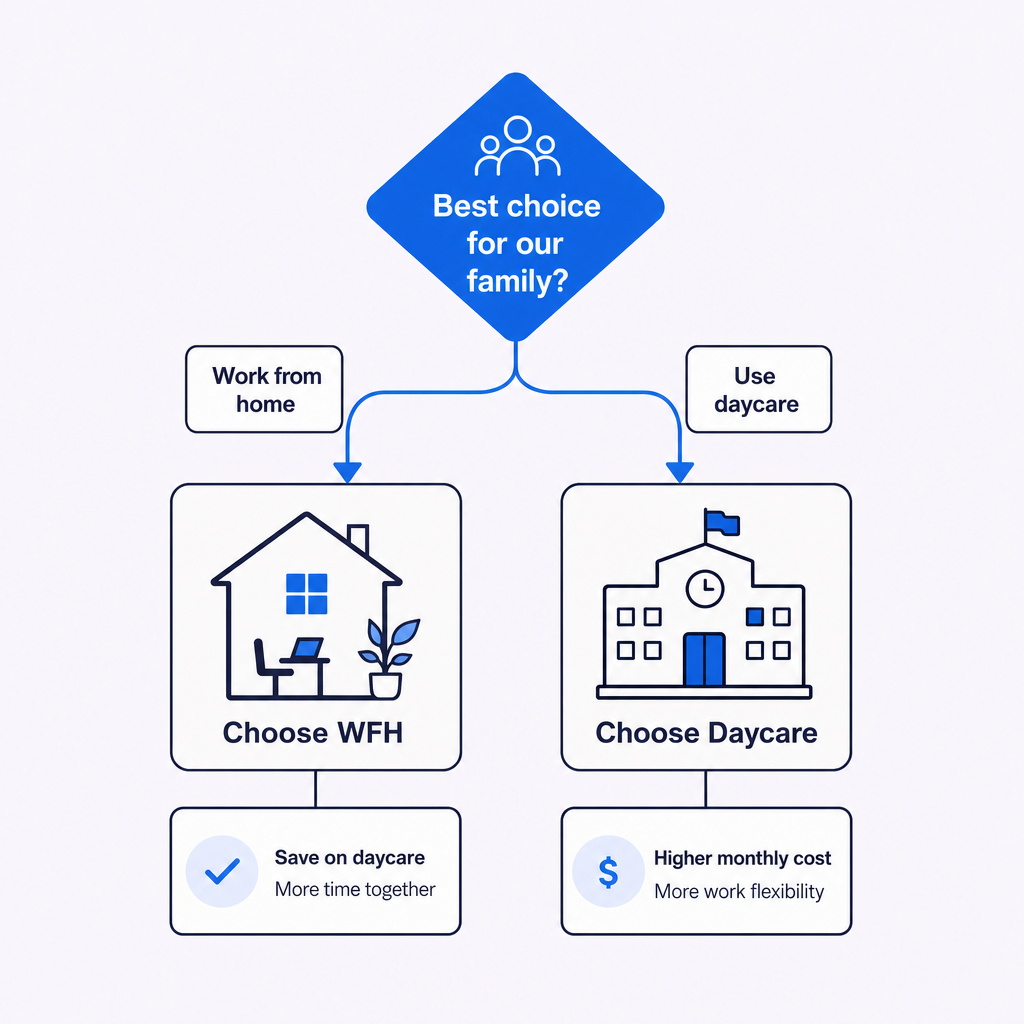
The framework that actually works:
At $75,000+ household income: Daycare typically makes financial sense. Full earnings plus career growth usually outweigh daycare costs over a 10-year horizon, especially once tax credits are applied.
At $40,000-$75,000: Model your specific numbers carefully. Consider part-time daycare, but account for the career stagnation cost before concluding WFH is cheaper. It often isn’t over five years.
Under $40,000: The system is genuinely broken here. Subsidies cover only 1 in 6 eligible children, and daycare can consume 30-50% of income. This is less a personal finance decision and more a policy failure.
The one thing to be honest about: if your employer expects 8 hours of output and you’re delivering 3-4, that’s not a sustainable solution. The savings won’t last, and the career cost will.
ParentWorth
ParentWorth runs the real numbers on childcare decisions – including the long-term income and career calculations that most budget tools leave out. If you’re weighing WFH versus daycare costs in your city, the cost breakdown guides cover daycare rates by region, tax credit optimization, and how this decision interacts with other parenting finance choices like the daycare vs. nanny comparison.
Frequently Asked Questions
Can you really work full-time from home while watching a young child?
Not reliably, no. Stanford WFH research puts baseline fully-remote productivity loss at around 10%, and that figure gets worse when children are present. Most parents with kids under 5 report only 3-4 focused work hours per day – not the 7-8 an employer expects. Some jobs can accommodate this; most can’t.
At what salary does paying for daycare make financial sense?
For most households earning $75,000 or more, daycare pays for itself through preserved career growth, full productivity, and employer benefits. The break-even depends on your salary, local daycare rates, and the tax credits available to you – but for higher earners, skipping daycare to WFH typically costs more in lost income over 5-10 years than daycare ever would. Use ParentWorth to model your specific numbers.
What is the part-time daycare hybrid approach, and does it actually work?
Part-time daycare (2-3 days per week) combined with WFH on the remaining days cuts costs by 40-60% while preserving some of the socialization and uninterrupted work time that make full-time daycare worth it. Parents in online communities consistently report this is the most sustainable middle-ground option, though it requires an employer willing to accommodate a non-standard schedule.
What are the long-term career costs of skipping daycare to work from home with kids?
Research shows each year out of the workforce carries roughly a 5% wage penalty, and these penalties compound – a parent who works part-time or at reduced capacity for three years may find their wage baseline permanently lower. Missed promotions and reduced professional visibility add further costs that don’t show up in monthly budgets but matter significantly over a decade.
How much do tax credits actually reduce daycare costs?
The 2026 Dependent Care FSA limit is $7,500, saving roughly $1,650-$2,000 in federal and payroll taxes for a household in the 22% bracket. The Child and Dependent Care Tax Credit covers 20-35% of up to $3,000-$6,000 in expenses, though you can’t claim both on the same dollars. Combined with employer child care benefits and state programs, many families can cut their effective daycare cost by 25-35%.