
Moving to a bigger place after a baby feels necessary. It’s not. We break down the rent/mortgage premiums, commuting costs, and the break-even point where moving actually makes financial sense.
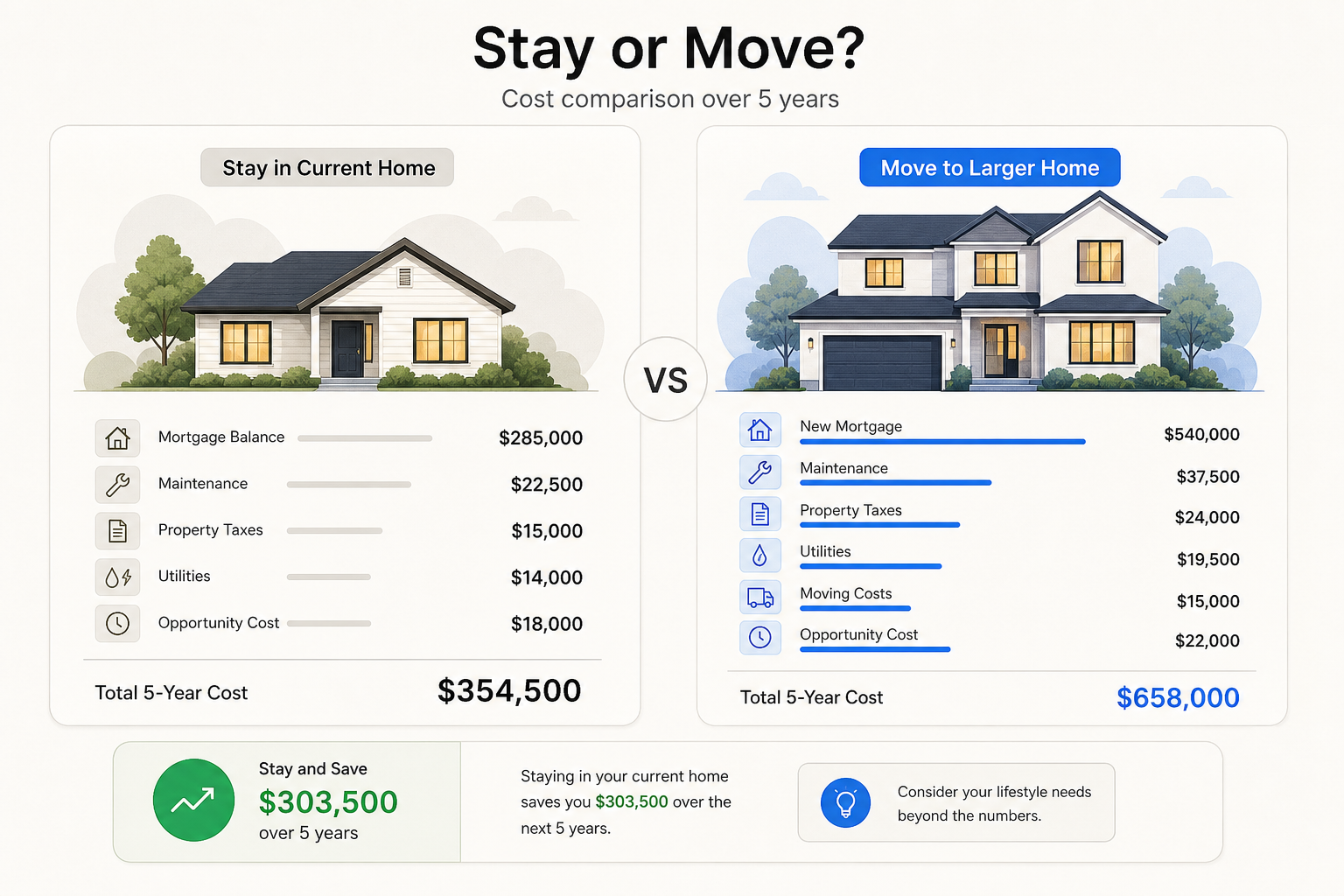
You’re holding a newborn. Your 900-square-foot one-bedroom apartment suddenly feels cramped. Your partner mentions the larger place two neighborhoods over. It’s spacious, modern, has a real nursery and a second bedroom. The rent is 40% higher.
But is it necessary? And more importantly, is it affordable?
The answer to both is usually no.
Babies don’t need space. Toddlers need slightly more space. The real space crunch arrives at child #2 or #3, and even then, “needing” a bigger place is different from “wanting” one.
From a pure financial perspective, moving after your first baby is almost always a net loss. The rent/mortgage premium exceeds any benefit from the additional space, especially when you factor in commuting costs.
The cost of moving: It’s more than rent
When parents talk about “upgrading to a bigger place,” they think about rent or mortgage. But that’s one-third of the actual cost.
| Moving Cost | Typical Impact |
|---|---|
| Rent/mortgage increase | $400-$1,500/month |
| Commuting cost increase (longer distance) | $50-$200/month |
| Moving costs (one-time) | $2,000-$5,000 |
| Property tax increase (if buying) | $50-$300/month |
| Furniture & setup for new space (one-time) | $1,000-$3,000 |
| Total annual cost | $6,000-$20,000+ |
For a family barely holding onto their first child while working, an extra $500-$1,000/month is a luxury, not a necessity.
Scenario 1: The 1-bed to 2-bed move in a moderate metro
Current situation:
- 900-square-foot 1-bed in a central neighborhood
- Rent: $2,000/month
- Commute: 15 minutes, one bus ($80/month)
The upgrade:
- 1,200-square-foot 2-bed, 2 miles further out
- Rent: $2,700/month
- Commute: 30 minutes, two transfers ($120/month)
| Cost Factor | Current | New | Difference |
|---|---|---|---|
| Monthly rent | $2,000 | $2,700 | +$700 |
| Commute cost | $80 | $120 | +$40 |
| Electricity (larger space) | $120 | $180 | +$60 |
| Internet/utilities | $60 | $70 | +$10 |
| Monthly total | $2,260 | $3,070 | +$810 |
| Annual cost | $27,120 | $36,840 | +$9,720 |
The 1-bedroom costs $27,120/year. The 2-bedroom costs $36,840/year. That’s $810 per month in additional housing + living costs.
What does your baby actually use in that extra bedroom? A crib for 18-24 months. A toddler bed for another 2-3 years. Then it’s a bedroom.
For a newborn, the extra space is convenience, not necessity. The financial premium for that convenience is steep.
Scenario 2: Expensive metro (SF, NYC, Boston)
The problem is worse in expensive markets.
Moving from 1-bed to 2-bed in San Francisco:
- Current: 800-sq-ft 1-bed, $3,000/month
- New: 1,100-sq-ft 2-bed, $4,500/month
- Difference: +$18,000/year
Plus commuting costs, which are already high. A 20-minute longer commute in the Bay Area adds $100-$200/month via longer car maintenance, tolls, or transit.
Total additional cost: $20,000-$22,000 per year for the privilege of more space.
That’s not trivial for any family, and it’s brutal for families on tight household budgets.
The space-not-needed phase: Birth to age 3
A newborn needs:
- A safe sleep space (bassinet or crib in your room for the first 6-12 months)
- Diaper changing station (can be a dresser with a pad; doesn’t need a separate nursery)
- Storage for clothes and gear (a closet works; doesn’t need a second bedroom)
A toddler (age 1-3) needs:
- A transition sleep space (toddler bed or small bed, can be in your room or a separate room)
- Toy storage (fits in a corner of a living room)
- A play space (can be a corner of your bedroom or living room)
None of this demands an extra bedroom. It demands organization and creative use of your current space.
Space optimization alternatives to moving
Before you move, try these:
| Optimization | Cost | Space Gained |
|---|---|---|
| Murphy bed (converts living room to bonus room) | $1,500-$3,000 | 200 sq ft (part-time) |
| Wall-mounted desk + storage system | $500-$1,500 | 150 sq ft (frees floor space) |
| Vertical shelving & closet organizers | $300-$800 | 50-100 sq ft (functional) |
| Remove large furniture (couch → futon) | $200-$800 | 100-150 sq ft |
| Total investment | $2,500-$6,100 | 400-600 sq ft effective |
A $3,000 closet renovation + Murphy bed setup buys you 2-3 years in your current space. That’s 24-36 months of $810/month premiums you avoid. That’s $19,440 in rent savings.
For most families, the $3,000 investment pays for itself in 4 months.
When moving makes sense: The inflection points
Moving for more space is justified when:
- You’re expecting child #2 or #3 within 12-18 months, AND your current space is genuinely too small (e.g., one bedroom for a family of three).
- The commute savings offset the rent increase. You’re currently 35 minutes away and can move to 20 minutes for the same price (rare, but happens in expanding suburbs).
- Your family income has grown significantly, and the housing cost ratio is still healthy (housing should be 25-30% of income; beyond that, you’re spending too much).
- You’re buying, not renting. Ownership builds equity, so the premium is partially recovered through appreciation. Rent is pure cost.
Most families moving after their first baby don’t meet these criteria.
The psychological pull: Why we want to move
The space hunger after a baby isn’t actually about space. It’s about feeling overwhelmed.
The nursery, the gear, the diaper stacks, the formula bottles, the clothes in three sizes simultaneously-it feels like you need more room.
But what you actually need is better organization, fewer things, or a few shelves of clever storage.
The urge to move is strongest at month 3-6 postpartum, when the newborn fog is thickest and everything feels harder. This is precisely the wrong time to make a housing decision that locks you into $800+/month additional costs for years.
The decision framework
If you have one child under 2:
- Stay put. Organize your current space.
- Budget $2,000-$4,000 for storage, organization, and space optimization.
- Plan to revisit housing when child #2 arrives (or after 3-4 years, if one child is your plan).
If you’re planning 2+ children close together:
- Move once, not multiple times.
- Move to a 2-bedroom when pregnant with child #2, not child #1.
- Calculate the actual cost-per-month and ensure it’s under $600 additional rent/mortgage.
If you’re already feeling space-deprived in your current place:
- First step: clear out. Most urban homes have 30-40% “stuff” that adds clutter without value.
- Second step: reorganize. Vertical storage, wall space, closet systems.
- Third step: move, if those fail. But try the first two first.
The move from 1-bedroom to 2-bedroom with a baby feels urgent. It almost never is. The space you’re missing is usually purchased for $2,000-$4,000 in optimization, not $9,000-$20,000/year in rent.
Wait. Organize. Move later, when you actually need more bedrooms, not just fewer baby blankets visible on your couch.
Frequently Asked Questions
How much extra space does a baby actually need?
An infant needs a safe sleep space (crib/bassinet) and a few feet of storage. A toddler needs a bedroom. Most families can squeeze a second child into a 1-bedroom + den or a small 2-bedroom. The move to ‘need’ a bigger home usually happens at child #2 or #3, not at child #1.
What’s the typical rent increase when you move to a bigger place?
Moving from a 1-bed to a 2-bed typically increases rent by 30-50% depending on location and market. In expensive metros (SF, NYC, Boston), it can be 50-70%. That’s an extra $500-$1,500 per month for modest markets, $2,000+ in expensive ones.
Does moving always increase your commute costs?
Not always, but often. If you move further from the city center to afford space, commuting costs (fuel, parking, tolls, time) typically rise by $50-$200/month. This partially offsets the ‘space is cheaper far from the center’ logic.
What’s the break-even point for moving vs staying?
If your extra housing costs exceed $400-$600/month and your commute gets worse, staying put is usually better financially. If space costs are under $300/month and commute stays the same, moving is viable—but make sure you need the space first.
Can you optimize your current space instead of moving?
Yes. A Murphy bed, wall-mounted desk, vertical storage, and removing unnecessary furniture can buy 2-3 years in a 1-bedroom. If you’re planning to stay in the city long-term, space optimization is usually cheaper than moving.