A basic convertible car seat has a list price of about $40. A well-known “premium” convertible, built with an all-steel frame and its own extra crash testing, runs $560. Both have to pass the exact same federal crash test before they can be sold in the United States. So what does the other $520 actually buy?
Every child restraint sold in the US, budget or expensive, has to meet Federal Motor Vehicle Safety Standard No. 213, the crash-test rule enforced by the National Highway Traffic Safety Administration (NHTSA). There’s no legal “safety tier” a manufacturer can skip by charging less. A second rule, FMVSS 213a, adds a mandatory side-impact test for every new seat starting December 5, 2026 — which means the side-impact testing some premium brands have marketed as an extra is about to become the law for everyone.
Below: what three real convertible seats cost today, what the price gap buys beyond the federal floor, and simple rules for deciding whether to spend more.
What the extra money actually buys
These are three real convertible car seats (they rear-face, then forward-face; they’re a different category from infant “bucket” seats that click into a stroller). Prices change often, so treat these as a snapshot, not a quote.
| Tier | Example and price | Rear-facing limit | Forward-facing limit | Booster mode |
|---|---|---|---|---|
| Budget | Cosco Scenera NEXT, about $40 | 40 lb | 40 lb | None |
| Mid | Graco Extend2Fit 3-in-1, $202.49 (list $269.99) | 50 lb | 65 lb | 40–100 lb |
| Premium | Clek Foonf, $559.99 | 50 lb | 65 lb | None |
Two things stand out. First, the mid-tier seat’s weight limits match the premium seat’s almost exactly, and it adds a highback booster mode the premium seat doesn’t have. Second, Clek says the Foonf’s price also covers an all-steel frame, a “crumple zone”-style energy-absorbing system, rigid-LATCH connectors for a tool-tight install, and, in the company’s words, “side-impact and other extensive due-care testing” beyond what’s currently required. Those are real, specific things. “More safety” in general isn’t one of them, because the budget and mid-tier seats already have to clear the same federal test.
The assumptions
Assumptions
- We compare convertible seats only (rear- and forward-facing, some with a booster mode), not infant “bucket” seats or dedicated boosters. Infant seats and travel systems have their own price range, but the same FMVSS 213 floor applies to them too.
- For the cost-per-month math, we assume 4 years (48 months) of use for all three seats, so the comparison isn’t skewed by different families’ timelines. That’s our assumption, not a manufacturer figure; a seat with a booster mode can plausibly stay in use well past 4 years, which would lower its real cost per month further.
- Prices are from the makers’ or retailers’ sites, checked September 28, 2026. Sales and regional differences will change the numbers.
- We didn’t include resale value: we found no reliable secondhand pricing data for car seats, and most consumer-safety guidance advises against buying one used anyway (see below).
The cost per month
$519.99
How much more the $560 Clek Foonf costs than the $40 Cosco Scenera NEXT — about 14 times the price — for the same federal crash-test floor.
Source: ParentWorth calculation from Clek’s and Car Seats For The Littles’ prices, checked and accessed September 2026.
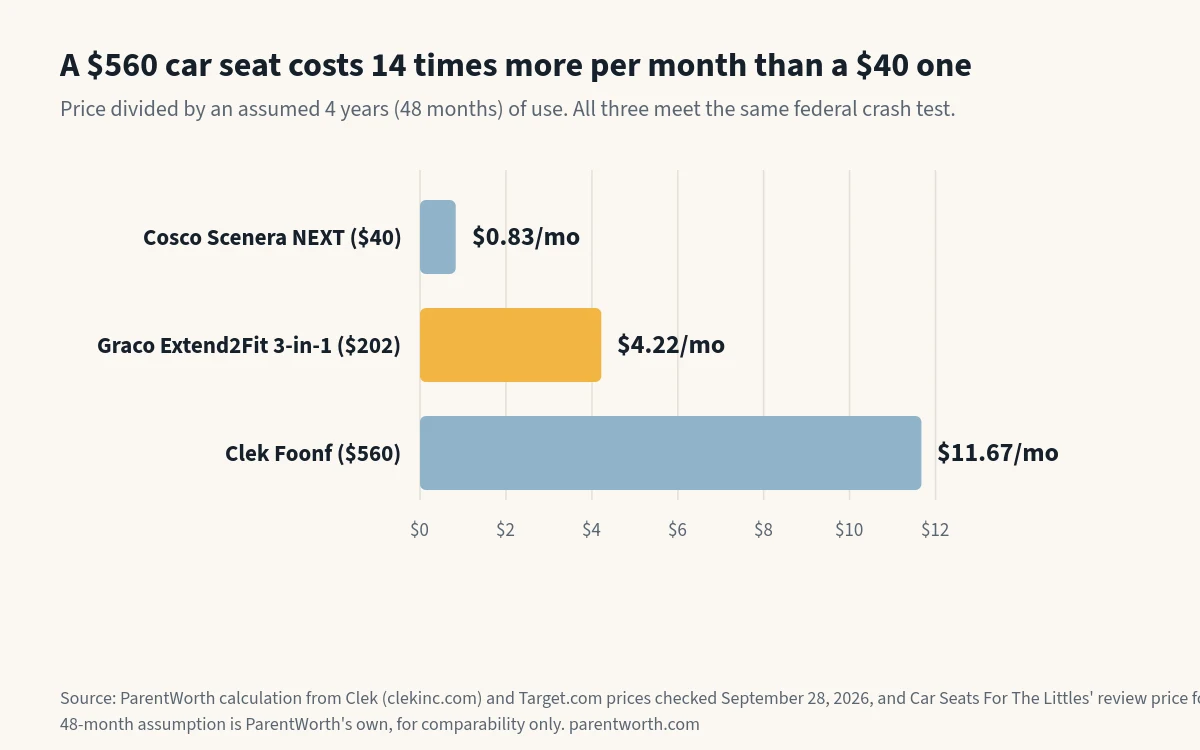
| Seat | Price | Per month, at 48 months |
|---|---|---|
| Cosco Scenera NEXT | $40.00 | $0.83 |
| Graco Extend2Fit 3-in-1 | $202.49 | $4.22 |
| Clek Foonf | $559.99 | $11.67 |
| Extra cost, Foonf vs. Scenera NEXT | $519.99 | $10.83 more per month |
It’s the same question we asked about $1,000 strollers and $300 baby monitors: does the extra money buy something you’ll actually use, or mostly the brand? For perspective, a car seat is usually a smaller line item than a year of feeding or diapers, but it’s still real money for a one-time purchase.
Buying used instead
Skipping the price gap by buying a used premium seat isn’t a straightforward money move either. Consumer Reports advises against used car seats generally: you can’t see stress fractures or weakened plastic from a past crash, seats have an expiration date (typically 6 to 10 years from manufacture, printed on the seat or in the manual), and you can’t be sure a secondhand seat hasn’t been recalled. We found no reliable resale-market pricing data for car seats, so we haven’t built it into the math above.
The federal safety floor, and a floor that’s about to rise
What is FMVSS 213?
Federal Motor Vehicle Safety Standard No. 213, first established in the 1970s, sets the crash-test requirements every child restraint system sold in the US has to pass, including frontal-impact protection. It’s a pass/fail floor, not a graded score: a seat is either certified to it or it can’t legally be sold.
What’s changing: NHTSA published a companion rule, FMVSS 213a, in June 2022, adding a mandatory side-impact test for seats designed for children up to 40 pounds (or the matching height range). Its compliance date was delayed once, from June 2025, and a final rule NHTSA published in September 2026 confirms the new date: every applicable seat manufactured on or after December 5, 2026 must pass it.
Early compliance is allowed, and some manufacturers are already there — Clek describes extra “due-care” crash testing on the $560 Foonf, and a car-seat-technician review of the $202 Graco Extend2Fit 3-in-1 says it already “meets new side impact standards.” In other words, the side-impact testing premium brands have used to justify higher prices is, within months, going to be a legal requirement for the $40 seat too.
This is a regulatory fact, not medical advice. Whether a specific seat fits your child and your car, and whether it’s installed correctly, is a question for your pediatrician or a certified Child Passenger Safety Technician (CPST), not a price comparison. The American Academy of Pediatrics says explicitly that “all parents can benefit from getting installation help from a CPST.”
Tip: use the free official tools
NHTSA runs a free Car Seat Finder tool and publishes Ease-of-Use Ratings for individual models, covering how clear the instructions are and how easy the seat is to install and use correctly. Before you buy on price alone, check NHTSA’s car seat and booster seat page for both, and check CPSC’s recall list for the model you’re considering.
Who should pay more, and who shouldn’t
Three car seats, one back row
You need three seats to physically fit side by side in a sedan or a small SUV. Width, not the crash standard, is what’s actually limiting you.
A narrow premium seat can be worth the extra cost here; measure before you buy.
One car seat, one budget
You need one convertible seat, your car isn’t unusually tight, and you want it to last from infancy through the booster years.
A well-reviewed mid-tier seat with a booster mode covers this for about $200, not $500-plus.
You’ve fought a LATCH install before
A standard flexible LATCH strap left the seat wobbly, or you never trust the recline angle.
Rigid-LATCH connectors, found on some premium seats, solve a real, specific installation problem.
Is it worth it?
Verdict: it depends
Most families don’t need to spend $500 or more. A well-reviewed convertible seat around $200 clears the same federal crash standards as the $560 seat, already includes a booster mode the premium seat doesn’t, and, per at least one car-seat-technician review, already meets the side-impact rule that becomes mandatory for every seat in December 2026. Pay more only when the premium seat solves a problem the mid-tier one genuinely can’t: fitting three seats across a narrow back row, or a LATCH install you’ve never gotten tight with a standard connector.
Decision rules
- If you’re buying a first convertible seat and money is tight, choose a well-reviewed seat around $150–270 with a booster mode; it clears the same federal test and can last through elementary school.
- If your back seat needs three car seats side by side, measure the narrowest seats first; that’s a real reason a premium model might fit when a budget one doesn’t.
- If you’ve never gotten a tight LATCH install with a standard seat, a rigid-LATCH premium seat is a legitimate reason to pay more, not just a nice-to-have.
- If a seller’s whole pitch is “extra safety,” ask which specific test they mean; by December 5, 2026, side-impact testing is a federal requirement for every new seat, not a premium extra.
- If you’re offered a secondhand seat to save money, skip it regardless of its original price, and check any seat’s expiration date before you rely on it.
- If you’re unsure a seat fits your child or your vehicle, that’s a question for a certified CPST or your pediatrician, not a price question.
Value pick: Graco Extend2Fit 3-in-1
Good for: the “one car seat, one budget” rule above. It’s the mid-tier example used in our cost tables: rear-facing to 50 lb, forward-facing to 65 lb, and a highback booster mode to 100 lb, so it can plausibly be the only convertible seat a family buys. The listing describes push-button LATCH for a one-step install.
Frequently asked questions
Do expensive car seats keep kids safer than cheap ones?
Not in the sense of clearing a higher legal bar. Every car seat sold in the US, at any price, has to pass the same federal crash test, FMVSS 213. Extra money typically buys convenience, fit, comfort and (until it becomes mandatory for every seat) an earlier start on new testing, not a different legal safety standard. Whether a specific seat is the right fit for your child is a question for your pediatrician or a certified Child Passenger Safety Technician.
What is FMVSS 213, and does every car seat have to pass it?
FMVSS 213 is the federal crash-test standard for child restraint systems, first established in the 1970s and enforced by NHTSA. Yes: it applies to every child restraint system legally sold in the United States, budget or premium.
What is FMVSS 213a, and when does it become mandatory?
FMVSS 213a is a newer standard, established in June 2022, that adds a side-impact crash test for seats designed for children up to 40 pounds. NHTSA delayed its original June 2025 compliance date once; a final rule published in September 2026 confirms every applicable seat manufactured on or after December 5, 2026 must meet it. Manufacturers can choose to meet it earlier, and some already do.
Is it safe to buy a used or secondhand car seat to save money?
Consumer safety guidance generally advises against it. You can’t verify a used seat’s crash history, some damage isn’t visible, and seats expire (typically 6 to 10 years from manufacture). If cost is the concern, a new budget or mid-tier seat that meets the same federal standard is usually the better trade than a used premium one.
How long should a convertible car seat last before I need a new one?
It depends on the seat’s own weight and height limits, your child’s growth, and its expiration date (also on the seat or in the manual). A seat with a booster mode, like the Extend2Fit, can potentially cover birth through the early elementary years in one purchase; a convertible-only seat without a booster mode will need to be followed by a separate booster seat.
Sources
- Federal Register / National Highway Traffic Safety Administration. FMVSS 213a side-impact protection, final rule, 91 FR 57265. September 9, 2026.
- Federal Register / NHTSA. Notice of enforcement discretion for FMVSS No. 213a, 90 FR 28909. July 2, 2025.
- HealthyChildren.org (American Academy of Pediatrics). Rear-Facing Car Seats for Infants & Toddlers. Accessed September 2026.
- U.S. Consumer Product Safety Commission. Car Seat recalls. Accessed September 2026.
- National Highway Traffic Safety Administration. Car Seat Finder and Car Seats & Booster Seats. Accessed September 2026.
- Clek. Foonf Slim Convertible Car Seat (product page). Checked September 28, 2026.
- Target. Graco Extend2Fit 3-in-1 Convertible Car Seat (product listing). Checked September 28, 2026.
- Car Seats For The Littles. Cosco Scenera NEXT Review. Accessed September 2026.
- Safe in the Seat. Graco Extend2Fit 3-in-1 (Meets New Standards) Review. 2026.
- Consumer Reports. Is it safe to buy a used car seat? Accessed September 2026.

2 comments