
Open enrollment asks you to make a childcare tax decision in November for money you will spend all next year. The usual advice is simple: max out the dependent care FSA. Since 2026 that advice needs a second look, because the law changed both sides of the comparison at once.
The FSA limit rose from $5,000 to $7,500. The child and dependent care credit also got richer: a married couple earning $100,000 now gets 35% back on up to $6,000 of care, up from 20%. You generally can’t use both on the same dollars, so one of them has to win. We ran the numbers at three household incomes, with one child and with two. This is general information, not tax advice; your own return can differ.
Both new rules are fixed dollar amounts in the law, with no inflation adjustment, so they carry into the 2027 plan year you are enrolling for now. Tax brackets do move with inflation. Our math uses the 2026 brackets, the latest the IRS had published when we ran the numbers on October 31, 2026; the 2027 brackets will shift the break-even points slightly.
What you’re choosing between
What is a dependent care FSA?
A dependent care FSA (flexible spending account) is an employer benefit. You choose an amount at open enrollment, it comes out of your paycheck before tax, and the plan pays you back when you submit care bills. Starting in 2026 the federal cap is $7,500 per household, or $3,750 if you’re married and file separately (IRS Publication 15-B).
The FSA money skips federal income tax and also Social Security and Medicare tax, which IRS Publication 15-B lists as exempt for dependent care assistance up to the $7,500 limit. That payroll tax is 7.65% for most employees, according to the Social Security Administration’s 2026 fact sheet. The credit can never give you that part.
The credit works differently. You claim it on Form 2441 when you file, as a percentage of up to $3,000 of care costs for one child under 13, or $6,000 for two or more. Under the July 2025 tax law (Public Law 119-21, section 70405), the percentage starts at 50% from 2026 and steps down as adjusted gross income (AGI) rises: 35% for married couples between about $43,000 and $150,000, then one point lower for each $4,000 above $150,000, bottoming out at 20% above $206,000.
For other filers the drop below 35% starts at $75,000. In 2025 everyone above $43,000 got 20%, which is why “always take the FSA” used to be safe advice.
The two are linked dollar for dollar. Every FSA dollar you exclude reduces the $3,000 or $6,000 credit limit. The IRS draft 2026 Form 2441 instructions say it plainly: if you exclude the full $7,500, you can’t take the credit, because $7,500 is more than either limit. Under the old $5,000 cap, a family with two kids could still claim the credit on the last $1,000. With a full $7,500 election, that leftover is gone.
The numbers for two kids
Assumptions
- Married couple filing jointly, both working, standard deduction of $32,200 for 2026, wages equal to AGI.
- Care for children under 13 costs at least $7,500 a year, so a $7,500 FSA is fully used and the credit can use its full $3,000 or $6,000.
- Each parent earns less than the Social Security wage base ($184,500 in 2026, $192,300 in 2027), so FSA money avoids the full 7.65%. At $300,000 it also avoids the 0.9% extra Medicare tax that applies to couples above $250,000.
- Federal taxes only. State income tax is left out.
- At these incomes the federal tax bill, $7,640 or more before credits, is bigger than the credit, so the credit is fully usable.
| Two kids | $100,000 | $180,000 | $300,000 |
|---|---|---|---|
| Income tax bracket for the FSA money | 12% | 22% | 24% |
| FSA: income tax saved on $7,500 | $900.00 | $1,650.00 | $1,800.00 |
| FSA: payroll tax saved on $7,500 | $573.75 | $573.75 | $641.25 |
| FSA total saving | $1,473.75 | $2,223.75 | $2,441.25 |
| Credit rate | 35% | 27% | 20% |
| Credit on $6,000 (no FSA) | $2,100.00 | $1,620.00 | $1,200.00 |
| Better option | Credit by $626.25 | FSA by $603.75 | FSA by $1,241.25 |
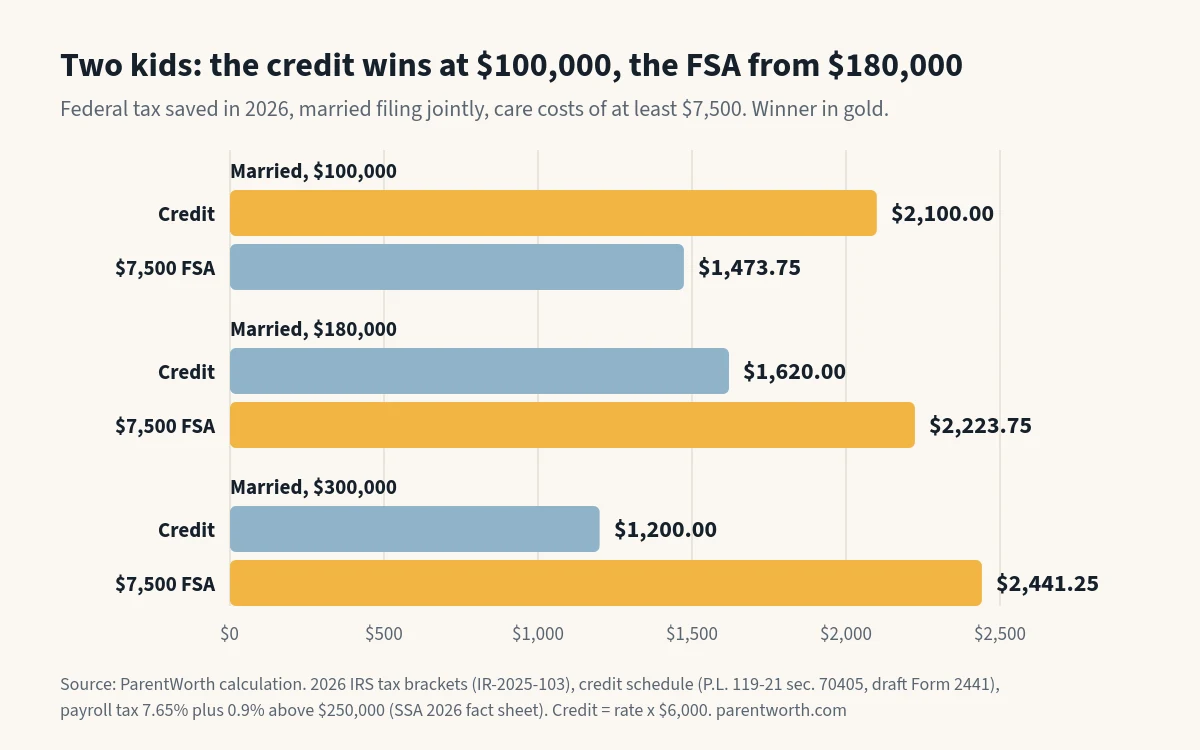
The pattern is clean. In the 12% bracket the FSA saves 19.65 cents per dollar (12% plus 7.65%), and the credit pays 35 cents on each of the first $6,000. The credit wins even though it covers $1,500 less spending. In the 22% bracket the FSA saves 29.65 cents per dollar on $7,500, and the credit has already started shrinking, so the FSA wins.
About $139,000
The household income where, with two kids and a full $7,500 of care, the FSA catches up with the credit. Below it the credit saves more; above it the FSA does.
Source: ParentWorth calculation from 2026 IRS brackets, the credit schedule in P.L. 119-21 and 7.65% payroll tax.
Mixing the two doesn’t beat the better one. At $100,000 with two kids, a $3,000 FSA plus the credit on the remaining $3,000 saves $1,639.50, less than the credit alone. At $180,000, the full FSA beats every split we tried. The only common case where both help is an employer plan that still caps the FSA at $5,000: at $180,000 that plan plus the credit on the last $1,000 saves $1,762.50, still more than the credit alone ($1,620.00).
With one child, the FSA usually wins
The credit for one child only applies to $3,000 of spending, so it tops out at $1,050 (35% of $3,000) for a married couple earning $100,000. The FSA can shelter $7,500.
| One child | $100,000 | $180,000 | $300,000 |
|---|---|---|---|
| FSA total saving on $7,500 | $1,473.75 | $2,223.75 | $2,441.25 |
| Credit on $3,000 (no FSA) | $1,050.00 | $810.00 | $600.00 |
| Better option | FSA by $423.75 | FSA by $1,413.75 | FSA by $1,841.25 |
The catch is spending. At $100,000, the FSA only beats the $1,050 credit if you put in and spend more than about $5,344 ($1,050 divided by 19.65%). A family paying for after-school care at a few thousand dollars a year can be better off with the credit. If you pay for full-time care, check your annual bill against that number; our daycare vs nanny breakdown walks through what a year of care can cost.
Costs people forget
Watch out: use it or lose it
FSA money you don’t spend on care is forfeited. Your employer may allow a grace period, but IRS Notice 2005-42 caps it at the 15th day of the third month after the plan year ends, about two and a half months. The forfeit eats straight into the saving: at $180,000 with two kids, the FSA’s edge over the credit is $603.75, so leaving more than that unspent means the credit would have done better.
The risk is a change in your care during the year. Kindergarten tuition doesn’t count as care, according to IRS Publication 503, though before- and after-school care can. A day camp can count; an overnight camp doesn’t. If a child starts school or a grandparent takes over pickups mid-year, your eligible spending drops while your payroll deduction doesn’t.
Three more limits apply to both options. The money you can count can’t exceed the lower-earning spouse’s earned income, so a parent earning $5,000 caps the household at $5,000. Your employer’s plan may not offer the full $7,500: the draft Form 2441 instructions say employers “may increase” the maximum, so check your enrollment materials. And both need the provider’s name, address and taxpayer identification number on Form 2441. Publication 503 suggests Form W-10 to collect it and says to keep that information with your tax records.
Which family are you?
Two kids, $100,000
Both in full-time daycare, married filing jointly, 12% bracket.
Skip the FSA. The credit saves $2,100.00 vs $1,473.75.
Two kids, $180,000
Same care, 22% bracket, credit rate down to 27%.
Max the FSA. $2,223.75 vs $1,620.00.
One child, any of our incomes
Full-time care of $7,500 or more a year.
Max the FSA. It beats the credit by $423.75 to $1,841.25.
Two cases fall outside our scenarios. Single parents filing as head of household see the credit start shrinking at $75,000 of AGI instead of $150,000, so in our reading the FSA is likely to win at lower incomes. Families earning well under $100,000 may owe too little federal income tax to use the whole credit, which can’t exceed your tax bill, and other credits interact with both options. There, run Form 2441 both ways in tax software before you enroll.
If you are still weighing whether both parents keep working, the childcare tax break is only one line of that budget; our stay-at-home vs dual income comparison covers the rest. For school-age kids, care hours compete with activities, which we priced in after-school activities per hour.
Keeping the paperwork
Whichever you choose, you need a year of care invoices and the provider details for Form 2441, and the FSA needs a claim for every reimbursement. A cheap monthly expanding file is enough to keep each month’s daycare bill, the matching FSA claim and the provider’s Form W-10 in one place.
Simple pick: Smead 12-pocket monthly expanding file (70186)

Good for: parents who pay for care month by month and want each invoice and claim filed under its month. The listing describes a letter-size kraft file with 12 pockets indexed January to December, pockets that expand to 7/8 inch, and a flap with an elastic cord closure. We have not tested it; any folder you will actually use does the same job.
Is it worth it?
Verdict: it depends
With one child and at least $7,500 a year of care, the $7,500 FSA saves more than the credit at every income we tested, as long as you really spend the money. With two kids, the new credit (35% of $6,000, or $2,100) beats the FSA for married couples earning under about $139,000. Above that, the FSA wins, by $603.75 at $180,000 and $1,241.25 at $300,000.
Decision rules
- If you have two kids in care and household income under about $139,000, skip the FSA and claim the credit on $6,000.
- If you have two kids and earn more than about $139,000, elect the FSA up to the care you are sure to pay.
- If you have one child, elect the FSA when you will spend more than about $5,344 on care; below that, the credit is close or better.
- If your care could stop mid-year (kindergarten, a move, a relative helping), elect only what you are certain to spend. A forfeit of $603.75 erases the FSA’s edge at $180,000 with two kids.
- If your employer still caps the FSA at $5,000 and you have two kids above about $139,000, take the FSA and claim the credit on the last $1,000.
Frequently asked questions
Can I use a dependent care FSA and the child care credit together?
Yes, but every FSA dollar cuts the $3,000 or $6,000 credit limit. Put in the full $7,500 and the credit is zero. With a $5,000 FSA and two kids, you can still claim the credit on $1,000.
Is a dependent care FSA worth it for daycare?
With one child, yes, if you are sure to spend what you elect and your care bill is above about $5,344 a year (at $100,000 of income). With two, it depends on income: under about $139,000 for a married couple, the 35% credit on $6,000 saves more under the rules that started in 2026.
How much does a dependent care FSA save?
Roughly $7,500 times your income tax bracket plus 7.65% payroll tax: $1,473.75 in the 12% bracket and $2,223.75 in the 22% bracket, before any state tax savings.
Is the $7,500 limit per parent?
No. It is $7,500 per household on a joint return, or $3,750 each if married filing separately. Two FSAs at two employers share the same cap.
What happens to money left in the FSA at year end?
It is forfeited unless your plan has a grace period, which can run to the 15th day of the third month after the plan year. The IRS calls this the use-it-or-lose-it rule.
Do summer camp and after-school care count?
Day camp can count, even a sports or computer camp. Overnight camp does not. Kindergarten tuition does not, but before- and after-school care can, according to IRS Publication 503.
Sources
- U.S. Congress. Public Law 119-21, sections 70404 (dependent care assistance) and 70405 (child and dependent care credit). Enacted July 4, 2025.
- Legal Information Institute. 26 U.S. Code § 21 and § 129. Accessed October 2026.
- IRS. Draft Instructions for Form 2441 (2026). Draft dated August 21, 2026.
- IRS. Instructions for Form 2441 (2025). Accessed October 2026.
- IRS. Publication 15-B (2026), Employer’s Tax Guide to Fringe Benefits. Accessed October 2026.
- IRS. IRS releases tax inflation adjustments for tax year 2026 (IR-2025-103). October 9, 2025.
- Social Security Administration. 2026 Cost-of-Living Adjustment (COLA) Fact Sheet and Contribution and Benefit Base. Accessed October 2026.
- IRS. Publication 503 (2025), Child and Dependent Care Expenses. Accessed October 2026.
- IRS. Notice 2005-42, Internal Revenue Bulletin 2005-23. 2005.