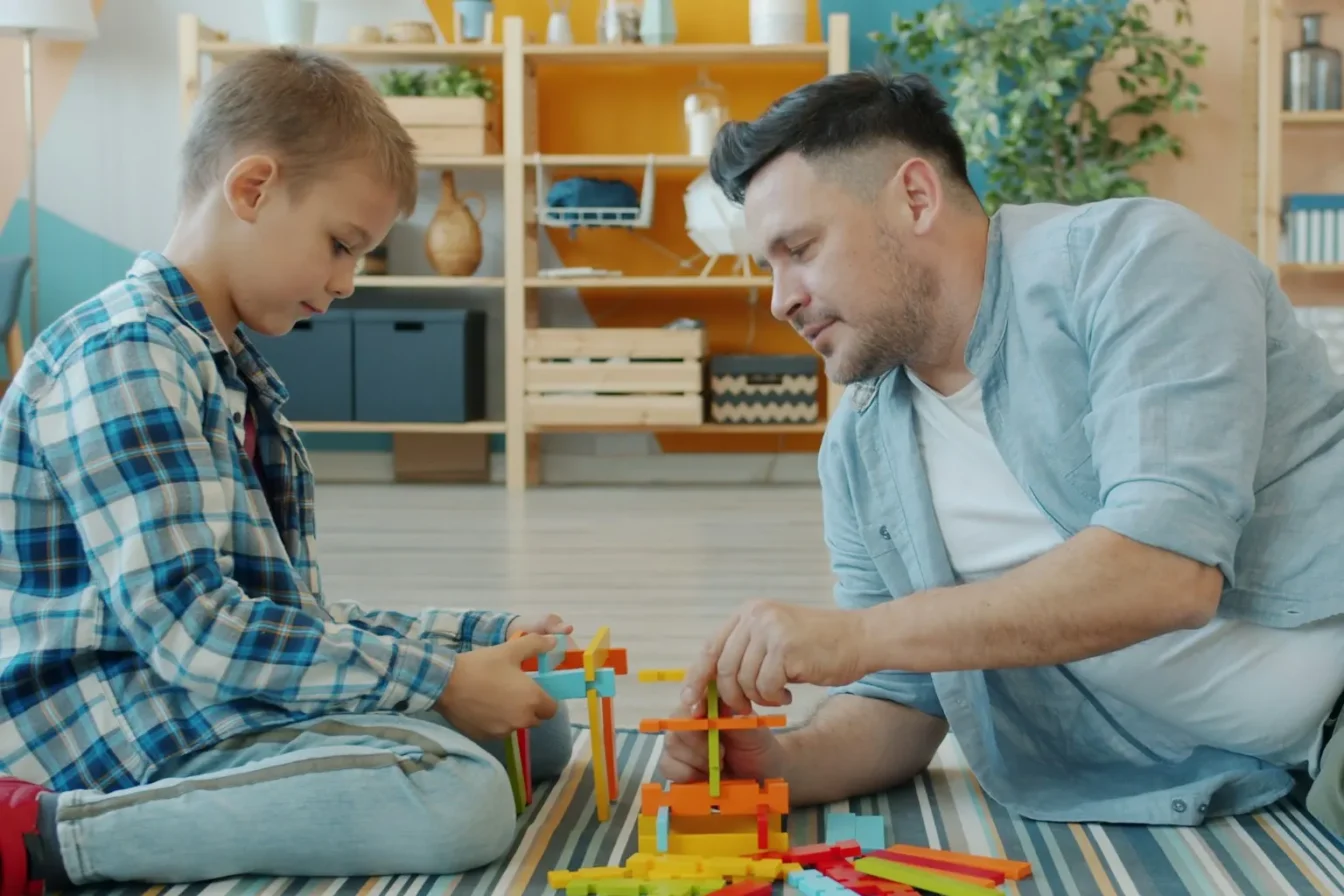
A 100-piece set of wooden blocks costs $24.99 on Melissa & Doug’s own site. A 100-piece set of magnetic tiles costs $119.99 on the MAGNA-TILES site. Both are construction toys, and one costs 4.8 times as much. The higher price implies your child will get more play out of it.
We went looking for evidence that price buys play and found none. What we did find: simple toys score well, fewer toys can mean longer play, and the federal toy safety rule doesn’t change with price. Then we ran the calculation the box can’t: cost per hour of play, the same test as in our after-school activities cost-per-hour breakdown. It’s also the premium-vs-budget question we asked about budget vs luxury strollers.
What the extra money actually buys
| Wooden blocks (budget) | Magnetic tiles (premium) | |
|---|---|---|
| Price on the manufacturer’s site, Oct 5, 2026 | $24.99 | $119.99 |
| Pieces | 100 | 100 |
| Price per piece | $0.25 | $1.20 |
| Material, per the manufacturer | Solid wood, 4 colors and 9 shapes | Plastic with magnets, translucent colors |
| Suggested age, per the manufacturer | 2+ | 3-99 |
Per piece, the premium set costs $1.20 against $0.25. You get magnets and see-through colors, but not a different kind of toy: both are sets a child builds with. Whether magnets are worth $95.00 is a taste question. Whether they buy more play is the question we can test.
The assumptions
Assumptions
- Prices are each manufacturer’s list price on its own site, checked October 5, 2026: $24.99 and $119.99. Stores run sales, so re-check before you buy.
- Hours of play are our assumptions, not measurements. Typical use: 3 hours a week, 52 weeks, 2 years, or 312 hours. Light use: 52 hours. Heavy use: 6 hours a week for 3 years, or 936 hours.
- Cost per hour = price ÷ (hours per week × weeks × years).
- No resale value, shipping or tax is included, and one child plays with the set unless a scenario says otherwise.
- This is a money comparison. It is not advice on what is good for your child’s development.
Cost per hour of play
4.8 times
How much more the $119.99 set costs per hour of play than the $24.99 set, at any amount of use, because both prices are divided by the same hours.
Source: ParentWorth calculation from the manufacturers’ list prices, checked October 5, 2026 ($119.99 ÷ $24.99 = 4.80).
| Use level | Hours of play | Wooden blocks, $24.99 | Magnetic tiles, $119.99 |
|---|---|---|---|
| Light: 1 hour a week for 1 year | 52 | $0.48 | $2.31 |
| Typical: 3 hours a week for 2 years | 312 | $0.08 | $0.38 |
| Heavy: 6 hours a week for 3 years | 936 | $0.03 | $0.13 |
| Hours of play to cost about $0.08 an hour | – | 312 | 1,498 |
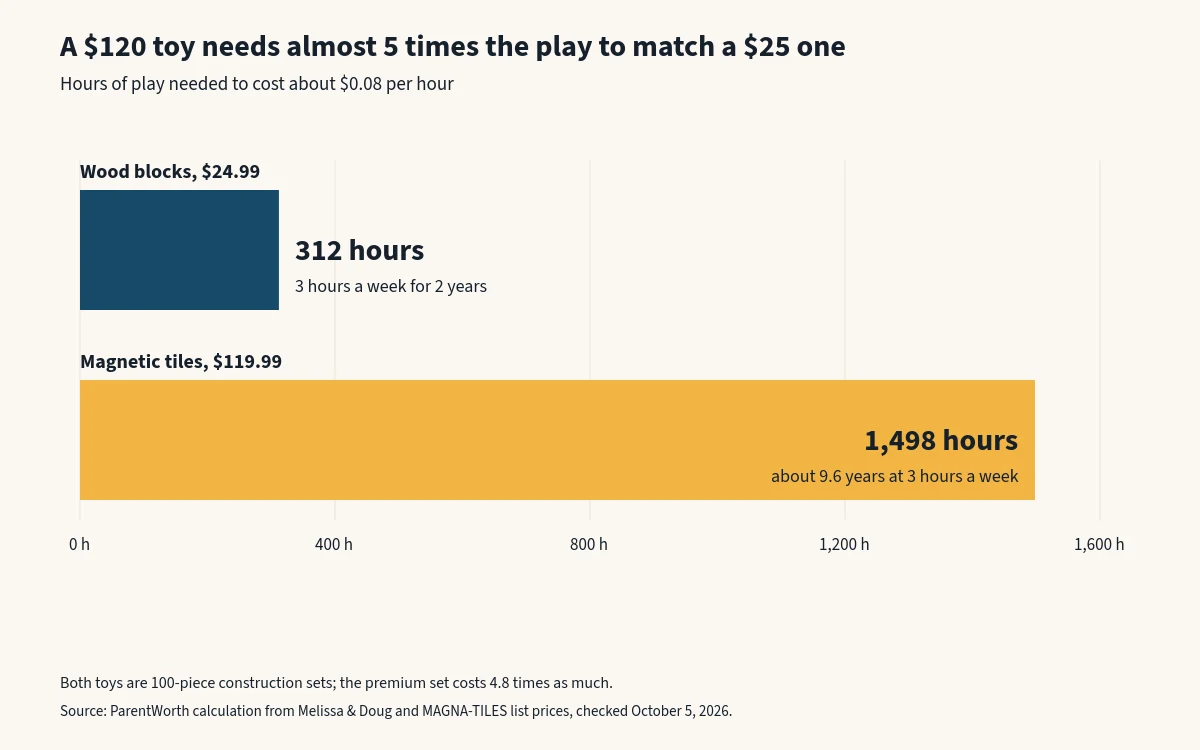
Read the last row as the test. The premium set needs 1,498 hours to cost what the wooden set costs at 312 hours. At three hours a week, that’s about 9.6 years of play. Even at heavy use, the premium set runs $0.13 an hour, which is more than the wooden set at typical use.
What the research says about price and play
We found no study that tests price directly. What exists tests toy type and toy quantity.
A University of Toledo team (Dauch, Imwalle, Ocasio and Metz) published a quantity study in Infant Behavior and Development in February 2018. Thirty-six toddlers aged 18 to 30 months each had two supervised play sessions, one with four toys and one with sixteen. With fewer toys, the toddlers had fewer incidences of toy play, longer durations of toy play and played with toys in a greater variety of ways. The university’s release put it simply: they "played twice as long with the toys they had."
It’s one small lab study, and it measured how many toys were in the room, not what they cost.
On toy type, Eastern Connecticut State University’s TIMPANI project has observed preschoolers on video for ten years. It reports that "the simplest toys support the most complex play," and its high-scoring construction toys include basic wooden blocks, Tinkertoys, Lincoln Logs and Duplo Blocks. Researcher Jeffrey Trawick-Smith adds that "children use less language when toys do the talking for them." In 2018 the American Academy of Pediatrics’ Aleeya Healey, MD, a lead author of its toy report, said: "the best toys need not be flashy or expensive or come with an app. Simple, in this case, really is better."
Our reading, as analysis and not as medical advice: both sets are open-ended construction toys, so none of this gives a reason to expect more play from the $119.99 set. It doesn’t say tiles are worse either. We found no ranking that separates them.
Safety rules don’t scale with price
What is ASTM F963?
ASTM F963 is the toy safety standard that Congress made mandatory for children’s toys in 2008. The U.S. Consumer Product Safety Commission says toys intended for children 12 and under must be third-party tested and certified as meeting the applicable rules. The current version, F963-23, applies to toys manufactured after April 20, 2024.
The rule applies by who the toy is for, not what it costs. We don’t rank safety here; for a specific product, check CPSC recall notices. Our $500 car seat comparison makes the same point about a federal floor.
Resale and hand-me-downs
We found no sourced resale prices, so the math assumes $0 back. Hand-me-downs are the real lever, because hours add up across children. If two siblings each play for the typical 312 hours, that’s 624 hours: $0.04 an hour for the wooden set and $0.19 for the tiles. Sharing shrinks both numbers but not the 4.8 ratio. For the bigger costs of a second child, see our one child vs two children comparison.
Who should pay more, and who shouldn’t
One child, casual play
Three hours a week for two years, 312 hours.
Buy the wooden set: about $0.08 an hour vs $0.38
Two siblings, daily building
Six hours a week for three years, shared by two children, 1,872 hours.
Tiles cost about $0.06 an hour, the wood set about $0.01. The tiles still cost $95.00 more up front.
Relatives who love toys
Fewer toys meant longer play in the Toledo study, and each added toy splits the same hours.
Buy one $24.99 set, not a pile
Is it worth it?
Verdict: Not worth it
For most families, the extra $95.00 does not buy more play. The premium set costs 4.8 times as much per hour at any level of use, and the research we found favors simple toys and a smaller pile, not a higher price.
It can make sense in one case: several children will share the set for years, and you simply like it. That is a preference. We found no evidence that it is a play upgrade.
Decision rules
- If you’re buying a first construction toy for one child, choose the $25 wooden set and keep the other $95.00.
- If a premium set will be shared by two or more children for years, do the division: price ÷ total hours. Past roughly 1,500 combined hours it matches the wooden set’s cost per hour at typical use.
- If the main selling point is "educational" or an app, ask what it does that a plain set doesn’t. The AAP said claims about educational benefits in interactive media ads are unsubstantiated.
- If you’re about to buy a fourth or fifth toy of the same kind, skip it. Your child’s hours stay fixed, so every added toy raises the cost per hour of all the others.
- If you can’t guess the hours, assume 312 (3 hours a week for 2 years) and divide.
What to buy
Budget pick: Melissa & Doug 100 Wooden Building Blocks
Good for: the first decision rule: one child and a first set. According to the manufacturer, it is 100 solid wood blocks in 4 colors and 9 shapes, for ages 2 and up, and FSC-certified. It comes with a storage box.
Frequently asked questions
Are expensive toys safer than cheap ones?
Not by law. CPSC says toys intended for children 12 and under must be third-party tested and certified under the mandatory ASTM F963 rules, whatever the price. We don’t rank safety. For a specific product, check CPSC recall notices.
Do educational toys help kids learn more?
We found no study that tests that by price. The AAP said in 2018 that educational claims in many interactive media ads are unsubstantiated, and that the best toys need not be flashy or expensive. For the money, divide the price by the hours it will get.
How many toys should a toddler have?
There is no official number, and we won’t invent one. The Toledo study compared four toys with sixteen in a 15-minute lab session. As a money rule: every extra toy shares the same fixed hours, so it raises the cost per hour of the toys you already own.
Do wooden toys hold their resale value?
We found no sourced resale data for either set, so we assumed $0. If you resell, count it as a bonus.
How do I work out cost per hour of play?
Divide the price by hours per week × weeks × years. A $24.99 set used 3 hours a week for 2 years is 312 hours, or about $0.08 an hour. A $119.99 set over the same hours is about $0.38.
What if I buy several cheap sets instead?
Four $24.99 sets cost $99.96, which is $20.03 less than one $119.99 set. But the hours stay fixed, so four sets split them four ways and each costs more per hour. Start with one and see how much it gets used.
Sources
- Dauch C, Imwalle M, Ocasio B, Metz AE. The influence of the number of toys in the environment on toddlers’ play. Infant Behavior and Development 50:78-87, February 2018 (PubMed record). DOI 10.1016/j.infbeh.2017.11.005.
- University of Toledo. Fewer toys lead to richer play experiences, UT researchers find. UToledo News, December 18, 2017.
- American Academy of Pediatrics, HealthyChildren.org. Ignore the Flashing Screens: The Best Toys go Back to the Basics. December 3, 2018.
- Eastern Connecticut State University. TIMPANI study coverage. Inside Eastern, 2020.
- U.S. Consumer Product Safety Commission. Toy Safety Business Guidance. Accessed October 2026.
- U.S. Consumer Product Safety Commission. Toy Safety FAQ. Accessed October 2026.
- Melissa & Doug. 100-Piece Wood Blocks Set. Accessed October 5, 2026.
- MAGNA-TILES. Classic 100 Piece Set. Accessed October 5, 2026.