Most elementary and middle schools that offer band or orchestra don’t ask whether you want to buy an instrument. They send home a list of approved models and a deadline, usually before the first class. For a first-time family, renting feels like the obvious safe choice. For a family whose older child quit clarinet after two years, buying can look like throwing money at a phase that might not last.
Most rent-vs-buy guides on this topic are written by a store that sells both, and they tend to blend two very different questions into one answer. A violin, viola, cello or bass is a sizing instrument: your child will physically outgrow it. A trumpet, clarinet, flute or most other band instrument is one fixed size for as long as they play it. That single difference changes which side of this decision wins, more than budget does.
Below: what renting and buying actually cost, using real 2026 rates from two of the largest US rental chains and real new-instrument prices, and where the two lines cross.
What you’re actually choosing between
There are really three options, not two: a straight rental you can return any time and own nothing; rent-to-own, where the store credits some or all of your payments toward buying that same instrument later; or buying outright, new (step-up or budget-tier) or used.
What is rent-to-own?
Music & Arts credits 100% of rental payments toward a purchase, and estimates it typically takes about 36 months to pay off an instrument this way. West Music instead offers a flat 30% discount if you buy out a rental at any time, plus 12 months of included repair service. Neither company publishes the exact mid-rental buy-out price, so treat these as general terms, not a guaranteed total.
The assumptions
Assumptions
- One child, one instrument, a typical elementary-through-middle-school band or orchestra commitment of roughly 1 to 4 years, the same multi-year framing we used for private vs public school costs.
- Rental rates are West Music’s published national starting rates, checked September 28, 2026: $15 a month for violin or viola, $33 a month for trumpet or clarinet, plus a $44.95 first month that bundles in the required method book, care accessories and a stand.
- Music & Arts doesn’t publish a national rate table (it says rates vary by location and school), so its rent-to-own terms are used qualitatively; West Music’s published rates are the basis for every dollar figure and chart.
- Purchase prices, checked the same date: a Music & Arts store-brand “entry-level” violin outfit ($899.99), a step-up Yamaha trumpet or clarinet bought at the same store ($1,869 / $1,431), and a budget-tier new trumpet or clarinet bought direct from Jean Paul USA ($309.99).
- Excludes private lesson costs (see our after-school activities cost-per-hour breakdown) and any separate school program fee.
- Prices vary by store, brand and region. Treat the numbers below as a realistic worked example, not a national average, and re-check current prices before you rent or buy.
The cost side by side
Renting a trumpet or clarinet for four years costs $1,595.95 at West Music’s published rate. Buying the exact step-up Yamaha model new, at the same chain’s own store, costs $1,869, more than four years of rent. The identical Yamaha model sells for about $1,280 at some online retailers; by year four, renting has already cost about $316 more than buying it there would have. Buy a well-regarded budget-tier trumpet or clarinet instead, at about $310, and renting stops being the cheaper option after about nine months.
It’s the same question we asked about pricier baby monitors: does the step-up price buy something you’ll actually use, or mostly a name?
| Year | Rent a trumpet or clarinet | Buy new, budget-tier (Jean Paul) | Buy new, step-up in-store (Yamaha) |
|---|---|---|---|
| Year 1 | $407.95 | $309.99 | $1,869.00 |
| Year 2 | $803.95 | $309.99 | $1,869.00 |
| Year 3 | $1,199.95 | $309.99 | $1,869.00 |
| Year 4 | $1,595.95 | $309.99 | $1,869.00 |
| 4-year total | $1,595.95 | $309.99 | $1,869.00 |
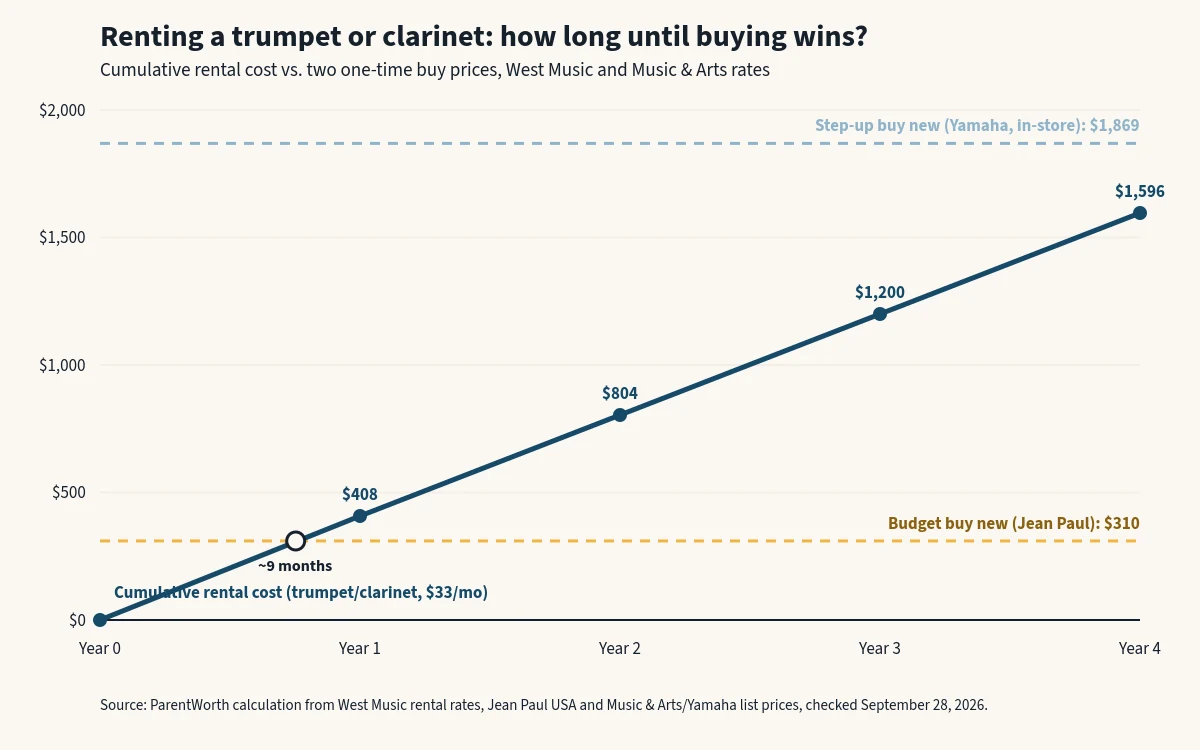
9 months
How long renting a trumpet or clarinet stays cheaper than buying a budget-tier new one outright, at West Music’s and Jean Paul USA’s current prices.
Source: ParentWorth calculation from West Music’s rental rate and Jean Paul USA’s list price, checked September 28, 2026.
None of this applies cleanly to a violin, viola, cello or bass, because of one more variable: size.
Why a growing string player changes the math
Violins are sold in fractional sizes. A typical progression runs from 1/8 size around age 5 to 6, up through 1/4, 1/2 and 3/4 sizes, before reaching a full 4/4 size around age 11 and up. Sizing follows arm length, not age alone, so an individual child can move through sizes faster or slower than that. A student who starts in elementary school will very likely need at least one, often two, size changes before they’re done growing.
Both major rental chains build this into their string programs by name. West Music’s violin rental lets you “exchange the instrument for a larger size at no additional cost” as your child grows. Music & Arts offers the same free exchange specifically for violin, viola, cello and string bass. Renting effectively pays for the sizing problem for you, folded into the same monthly rate.
Buying instead means either your child starts on a size they’ll outgrow within a year or two, or you pay for the instrument again at the next size. Even at the cheapest new violin outfit we priced, Music & Arts’ own $899.99 store brand, buying just two sizes over a few years costs $1,799.98 combined. That’s more than double what four full years of rental costs ($749.95). Buying once, at the last size your child will ever need, avoids the problem, but that’s rarely realistic for a 6- or 7-year-old just starting out.
Costs people forget
Watch out: damage and loss protection
Every West Music rental includes a “service protection plan” already folded into the listed monthly rate. Music & Arts sells an optional damage waiver for “a few extra dollars” a month that, in most cases, covers all repair, accidental damage or loss cost. Buy an instrument outright and you’re on the hook for repairs and loss out of pocket, unless you separately buy a maintenance plan. A beginner’s dented bell or cracked reed is common, not rare.
A rental’s first month already includes the method book, care accessories and a stand for that $44.95 starter payment. Buy an instrument outright and you’ll pay for those separately: a single instrument-specific method book alone runs about $13, plus a stand and basic care items on top.
Resale value is real if you buy, but don’t count on getting most of your money back. On Reverb’s marketplace, a used Yamaha trumpet like the one priced above recently sold for about $446: only 24% of the $1,869 you’d pay new at the same store that rents it, and less than a brand-new $310 budget trumpet would have cost from the start. A used Yamaha clarinet fared a little better, at about 29% of its in-store new price. If you buy, keeping the instrument and its case in playable condition matters more for resale than the brand name does.
Scenarios: when the answer changes
How likely is your child to actually keep playing? There’s no solid, verified US figure for beginning band and orchestra students specifically. A peer-reviewed study of older UK and German secondary students found about half had stopped by age 17, a different population from a new fourth grader; one informal survey of band directors put average annual attrition closer to 7% of enrolled students. Nobody can tell you the real odds for your specific child, which is exactly why the first year is worth treating as an unknown, not a guess to bet a purchase on.
Unsure if it’ll stick
The school just assigned an instrument. You have no idea yet whether your child will love it or quit by winter break.
Rent, whatever the instrument: about $210-$410 at risk in the first year, not $310-$1,869
A growing string player
A 7-year-old starting violin or cello, expected to stay in orchestra through middle school.
Keep renting through each size change: free exchanges beat buying twice
A committed band player
A full year in on trumpet, clarinet or flute, still enjoying it, instrument won’t change size.
Price a budget-tier new instrument: it likely beats 2-3 more years of rent
Beyond the money
Money isn’t the only reason rental programs exist. New band students sometimes discover in the first months that they’d rather play a different instrument than the one they started on, and a rental turns that into a simple exchange instead of a resale.
A rented string instrument from a shop that supplies school programs usually arrives already set up correctly: bridge, pegs, string height. A bought instrument, especially a cheaper one, may need that adjustment done separately before it plays well. Neither of those is a money question we can settle for you, and this article isn’t the place to weigh in on which instrument fits your child best musically. That’s a call for your child, and their band or orchestra teacher.
One more thing worth remembering: every number above is per child, per instrument. If a second child follows the first into band or orchestra a few years later, see our one child vs two children breakdown for how fast family costs like this one stack up.
Is it worth it?
Verdict: it depends
Rent for the trial year, no matter the instrument. It’s the cheapest way to find out whether your child will actually stick with it, and both major rental chains let you return the instrument or stop paying at any time.
After that, the two instrument types split. Keep renting a violin, viola, cello or bass for as long as your child is still growing: a free size exchange is worth more than owning a size they’ll outgrow, and buying new at each size can cost more than double a full four years of rent. For a fixed-size instrument like a trumpet, clarinet or flute, once your child has genuinely committed, buying usually costs less than continuing to rent. A budget-tier new instrument beats renting after about nine months, and even a step-up brand pays off within three to five years.
Decision rules
- If your child is just starting and you don’t know whether they’ll stick with it, rent for the first year, whatever the instrument.
- If it’s a sizing string instrument (violin, viola, cello, bass) and your child is still growing, keep renting: a free size exchange is worth more than owning a size they’ll outgrow.
- If it’s a fixed-size band instrument (trumpet, clarinet, flute and most others) and your child has committed for at least two more years, price a well-regarded budget-tier new instrument before you pay for another year of rental.
- If you do buy, add up what the rental’s starter bundle already includes (method book, stand, care kit) so those aren’t a surprise on top of the instrument price.
- If you rent either type of instrument, add the optional damage and loss protection: repairs on a beginner’s instrument are common, and the plan usually costs far less than one repair bill.
- Whichever path you choose, budget for a basic clip-on tuner: it’s a small, one-time cost that helps practice at home regardless of which instrument or path you pick.
Practice pick: Korg CA-2 Chromatic Tuner
Good for: the last rule above, whichever instrument and whichever path you choose. It’s a general-purpose clip-on/handheld tuner built for wind, string and keyboard instruments, with a detection range from A0 to C8, a needle-style meter with red/green LED pitch indicators, and about 100 to 200 hours of runtime on two AAA batteries.
Frequently asked questions
How much does it cost to rent a school instrument each month?
At West Music’s published national rates (checked September 2026), violin or viola rents for $15 a month, and trumpet or clarinet for $33 a month, plus a $44.95 first month that bundles in the method book, care accessories and a stand. Rates vary by store, region and instrument, so treat these as a starting point and check your own rental program.
Is it cheaper to buy a violin than to rent one?
Not usually, while your child is still growing. A new store-brand violin outfit we priced costs $899.99, versus $749.95 for four full years of rental. That figure also ignores that a growing child will likely need at least one more size during those years, which a rental exchanges for free but a purchase means buying again.
What happens to the money I’ve paid if my child quits?
With a straight rental, you simply return the instrument and stop paying; there’s no requirement to keep paying after that. You don’t get past payments back, but you also don’t owe anything more, and you never spent the full price of a purchase. That’s the core appeal of renting during an uncertain first year.
Do rent-to-own payments actually count toward buying the instrument?
At Music & Arts, yes: the company says 100% of rental payments apply toward a purchase, and estimates it typically takes about 36 months to pay off an instrument this way. West Music instead offers a flat 30% discount if you buy out your rental at any time. Neither company publishes the exact buy-out price at every point mid-rental, so ask your local store for the current figure before assuming a specific total.
Should I buy a cheap off-brand instrument instead of renting?
It can make financial sense once your child has committed. A budget-tier new trumpet or clarinet from a manufacturer like Jean Paul USA costs around $310, which beats renting after about nine months. The catch is that some school programs are particular about approved brands and models, and a beginner’s first months are easier on a well-adjusted instrument, so check with the band or orchestra teacher before buying, not after.
How often will a young violin or cello player need a bigger size?
It depends on the child’s growth, not a fixed schedule, but sizing guides commonly place a first violin around age 5 to 7 in a fractional size, moving up roughly every one to three years until a full-size instrument around age 11 and up. A child starting in elementary school should expect at least one, often two, size changes before they stop growing.
Sources
- West Music. Instrument Rental. Accessed September 28, 2026.
- West Music. Violin Rental. Accessed September 28, 2026.
- West Music. Trumpet Rental. Accessed September 28, 2026.
- West Music. Clarinet Rental. Accessed September 28, 2026.
- Music & Arts. Instrument Rentals for Students. Accessed September 28, 2026.
- Music & Arts. Instrument Rentals FAQ. Accessed September 28, 2026.
- Music & Arts. Rent to Own Programs: FAQs. Accessed September 28, 2026.
- Music & Arts. Strobel ML-80 Student Series Violin Outfit (product page). Accessed September 28, 2026.
- Music & Arts. Yamaha YTR-2330 Standard Bb Trumpet (product page). Accessed September 28, 2026.
- Music & Arts. Yamaha YCL-255 Standard Bb Clarinet (product page). Accessed September 28, 2026.
- Equipboard. Yamaha YTR-2330 and Yamaha YCL-255 retailer price comparisons. Accessed September 28, 2026.
- Jean Paul USA. Student Trumpet TR-330 (product page). Accessed September 28, 2026.
- Jean Paul USA. Student Clarinet CL-300 (product page). Accessed September 28, 2026.
- Strait Music. Eastman VL100 Samuel Eastman Student Violin Outfit, 4/4 (product page). Accessed September 28, 2026.
- Violin Lounge. Violin size chart: choose the right size violin. June 2, 2022.
- Naperville Music. Beginner Orchestra Rental Guide for Families. Accessed September 28, 2026.
- Dietze Music. Back-to-School Instrument Rentals: Your Family’s Complete Guide. July 18, 2025.
- Ruth, N. & Müllensiefen, D. Survival of musical activities. When do young people stop making music? PLOS ONE, 2021.
- Culp, M.E. & Clauhs, M. Factors that Affect Participation in Secondary School Music. Music Educators Journal (National Association for Music Education), June 2020.
- J.W. Pepper. Essential Elements Interactive, Book 1 (product listing). Accessed September 28, 2026.
- Korg USA. CA-2 Chromatic Tuner (product page). Accessed September 28, 2026.

2 comments