For many parents, the choice between public and private school is the largest financial decision they will ever make. We break down the true 13-year cost.
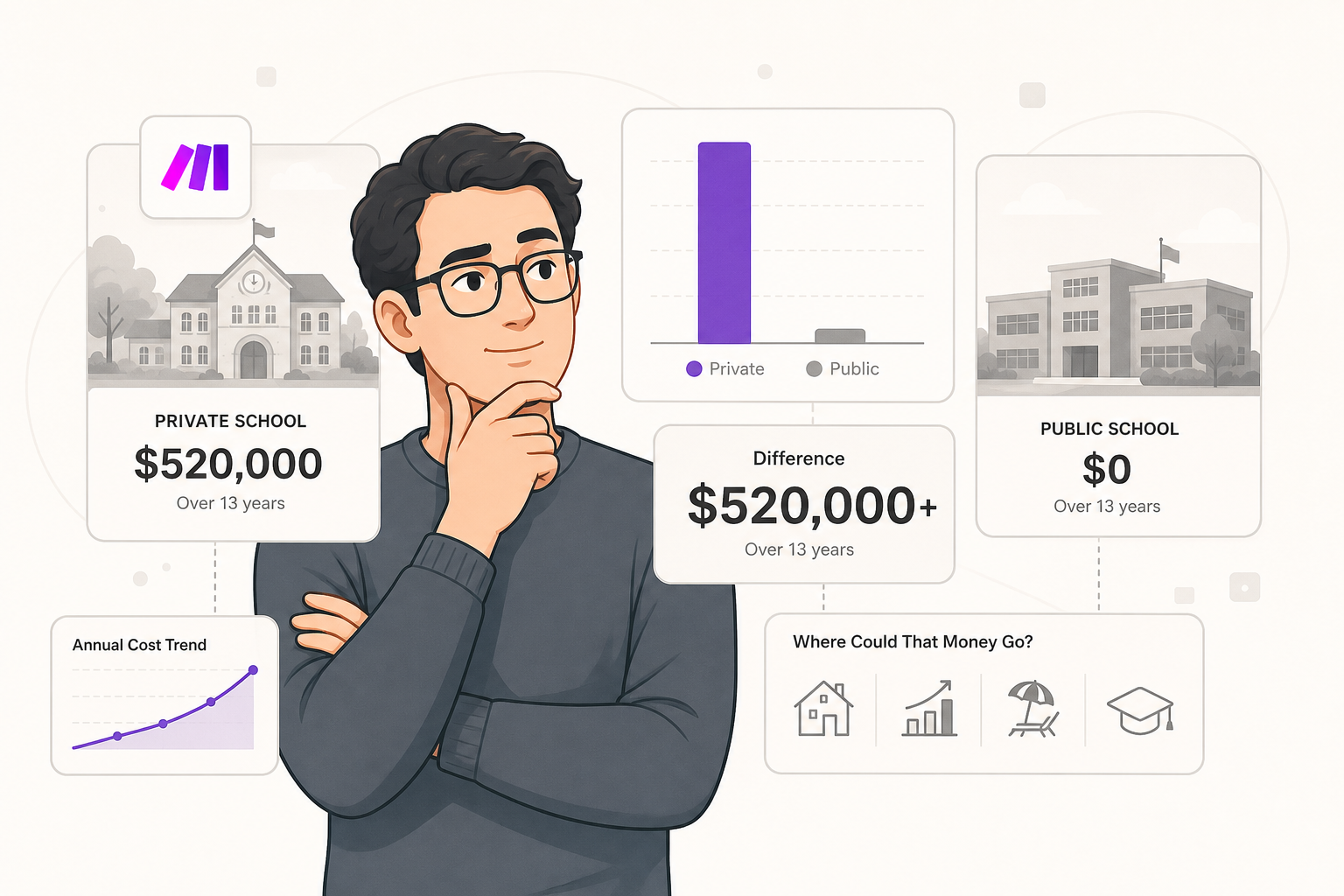
Most parents view the K-12 private school decision through the lens of academics and peer groups, but the real magnitude is financial. In 2026, putting one child through 13 years of private school in a major city costs roughly $520,000. We break down the true opportunity cost and the logic of when to pay.
For many parents, the choice between public and private school is the largest financial decision they will ever make. It is often a choice made with the heart, driven by a desire to give a child every possible advantage. However, when you step back from the emotional weight, the numbers tell a more complex story. Most families focus on the monthly tuition bill, but they frequently underestimate the cumulative impact of 13 years of private education on their household net worth. Our goal is to provide a clear, data-driven look at the total cost of ownership (TCO) of a K-12 education so you can make a decision rooted in logic rather than just intuition.
What is the $500,000 decision in this private vs public school cost comparison?
In high-cost-of-living areas like San Francisco or New York, local financial experts and parents have started referring to the K-12 choice as the $500,000 decision. This is not a hyperbolic figure. When you combine tuition for kindergarten through 12th grade in a major city, the total often crosses the half-million dollar mark per child.
The reason the cost is so high is not just the base tuition. You also have to factor in the annual inflation of education costs. Historically, private school tuition has inflated at a rate of approximately 5% per year, which is significantly higher than general inflation. If you start with a $35,000 kindergarten tuition in 2026, that same seat could cost nearly $60,000 by the time your child reaches their senior year. For a high-earning family in a 40% tax bracket, covering a $520,000 tuition bill requires earning over $850,000 in gross income.
Private school costs in 2026: From parochial to independent
Private education in the United States is not a monolith. Costs vary wildly depending on the type of school and the level of prestige. In 2026, we generally see three main tiers of private education that parents consider during a private vs public school cost comparison.
1. Parochial and religious schools
These are often the most affordable private options because they are frequently subsidized by a religious organization. In 2026, these schools average between $7,000 and $10,000 per year. For example, St. Thomas More School in San Francisco lists its 2026-2027 tuition at $10,500 for a single child.
2. Independent day schools
This is the “standard” private school experience that most professionals envision. These schools typically offer smaller class sizes and specialized curriculum. According to recent data from the National Association of Independent Schools (NAIS), the median tuition for an independent day school is now around $32,251.
3. Elite and prestigious institutions
At the top of the pyramid are schools like Phillips Academy Andover or Punahou School. These institutions offer world-class facilities and alumni networks that include presidents and CEOs. For the 2026-2027 academic year, Punahou’s tuition is $34,230, while Phillips Academy Andover charges $63,840 for day students and $79,800 for boarding students.
| School Tier | Est. Annual Tuition | Best For |
|---|---|---|
| Parochial / Religious | $7,000 – $12,000 | Families seeking values-based education on a budget |
| Independent Day | $25,000 – $38,000 | Standard private experience with small class sizes |
| Elite / Prestigious | $35,000 – $80,000+ | Families seeking top-tier networks and facilities |
Beyond the sticker price of tuition, there are several “hidden” fees that can add thousands to your annual bill. These are often overlooked in a basic private vs public school cost comparison.
| Fee Type | Estimated Cost | Frequency |
|---|---|---|
| Registration / Enrollment | $200 – $500 | One-time or Annual |
| Supply / Technology Fees | $150 – $350 | Annual |
| Annual Fund / Donations | $1,000+ (Expected) | Annual |
| Extracurriculars / Trips | $500 – $2,000 | Annual |
The true cost of “free” public school in a private vs public school cost comparison
It is a common misconception that public school is entirely free. While you do not write a tuition check, public school comes with its own financial trade-offs.
The most significant expense is the “Good District” premium. In many cities, homes located within the boundaries of top-rated public school districts trade at a 20% to 30% premium compared to similar homes in average districts. You are essentially pre-paying for your child’s education through your mortgage. If a home in a “good” district costs $200,000 more than a similar home elsewhere, the interest on that extra mortgage debt over 30 years can easily rival a private school tuition bill.
There are also logistical costs to consider. Public schools often have less flexible schedules. After-school care is frequently managed through lottery systems or third-party providers, which can cost several hundred dollars per month. Transportation is another factor; if your local school doesn’t provide a bus, the time or cost of commuting adds up.
One often overlooked value of public school is the federal mandate for Special Education under the Individuals with Disabilities Education Act (IDEA). Public schools are legally required to provide support for children with learning differences like ADHD or Dyslexia. Private schools are not bound by the same requirements. For a family with a child who needs significant support, the services provided by a public school could be worth $20,000 or more per year.
Opportunity cost: The $1.2 million trade-off in a private vs public school cost comparison
This is where we move to the “logic” of wealth building. When you spend $35,000 a year on tuition, you aren’t just losing that $35,000. You are losing what that money could have become if it were invested.
If you were to take $30,000 per year (a conservative average for private tuition in 2026) and invest it into a low-cost S&P 500 index fund with an average annual return of 7%, you would have a significant nest egg by the time your child graduates.
| Investment Scenario | 13-Year Value (Graduation) | 30-Year Value (Parent Retirement) |
|---|---|---|
| Investing $30k / Year | ~$600,000 | ~$2.8 Million |
| Paying Private Tuition | $0 | $0 |
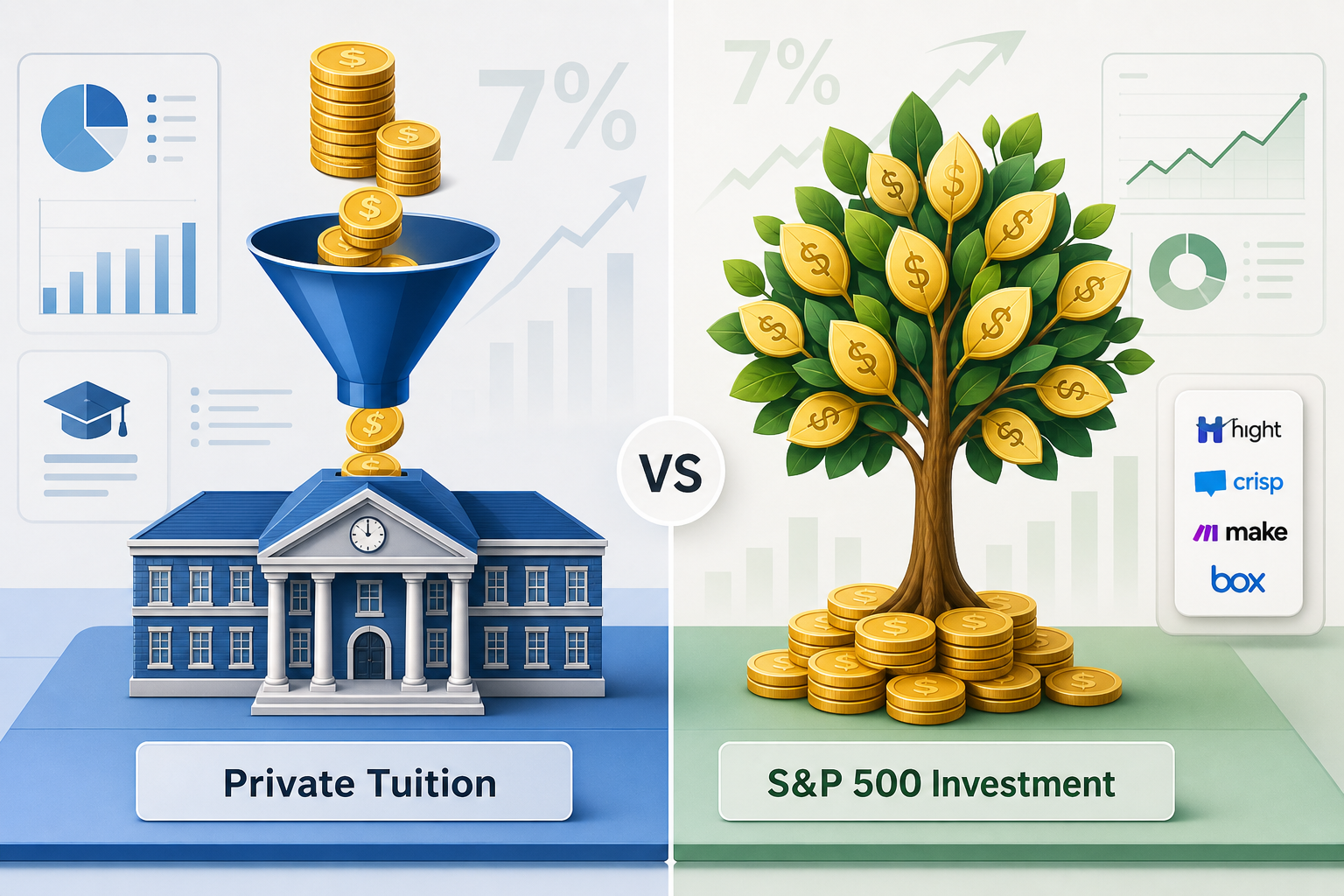
In this scenario, a child whose parents chose public school could graduate with a $600,000 brokerage account. Even 30 years later, it grows to nearly $2.8 million. For many families, this is a more powerful advantage to give a child than a private K-12 education. For the parents, spending after-tax dollars on tuition can delay retirement by 5 to 10 years.
Is it worth it? The logic of school choice in this private vs public school cost comparison
Deciding if private school is “worth it” requires simplifying the decision into specific value drivers.
The Nurture vs. Nature debate
Research suggests that parental involvement is a much stronger predictor of success than the type of school. A child with motivated parents in a solid public school often outperforms a child with less engaged parents in an elite private school.
The Alumni Network
However, the alumni network is a tangible asset. At “Tier 3” schools like Phillips Academy or Punahou, the peer group includes the children of the global elite. These connections can lead to career opportunities later in life. You are essentially buying your child a ticket into a specific socioeconomic stratum.
Real-World Exposure
Public schools generally offer a more realistic slice of the real world. Your child will interact with peers from a wider range of backgrounds, which builds social awareness. Private schools can be “sheltered,” which some parents view as a drawback. One parent noted in our research that the community passion in some public schools is something they never experienced in a private setting.
The “High School Only” Strategy
For the best return on investment, focus on private high school only. By opting for public school for K-8 and switching to a prestigious private high school for the final four years, you capture the prestige and elite network benefits at a fraction of the 13-year cost. You save roughly 70% of the total K-12 tuition bill while still providing the “elite” finish.
Decision rules: When to go private in 2026
To help simplify this $500,000 decision, here are five simple decision rules for parents in 2026.
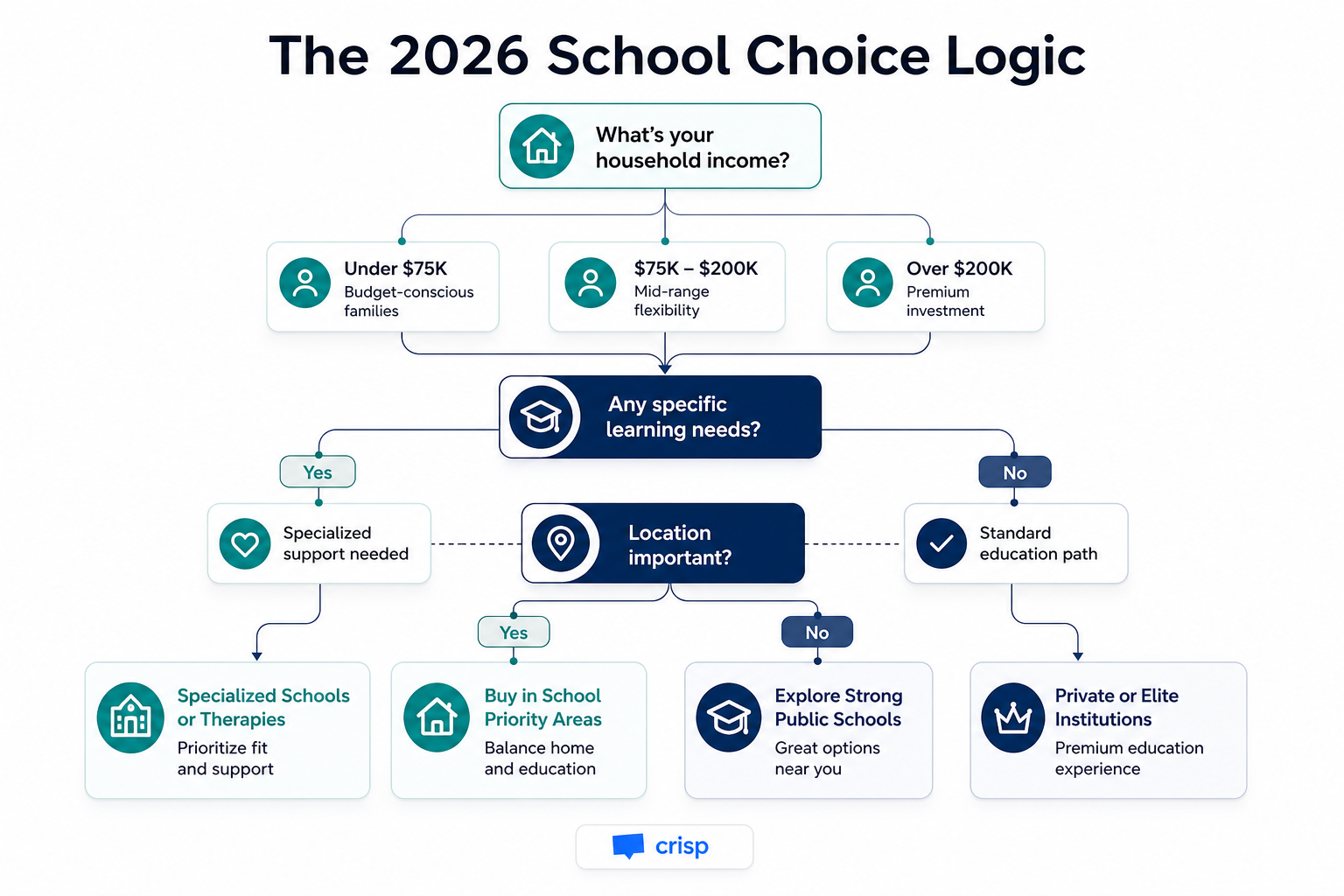
- IF your household income is less than five times the annual tuition, THEN public school is the only responsible path. Overextending yourself for K-12 tuition leads to parental stress and lack of retirement savings.
- IF your child has specific learning needs that require a very small student-to-teacher ratio, THEN the private premium may be worth it for the first few years of elementary school.
- IF your local public school is objectively failing, THEN prioritize moving to a better district before committing to private tuition. A larger mortgage is often more “recoverable” than spent tuition.
- IF you are choosing between a larger mortgage in a top district and private tuition, THEN run the mortgage interest math first. If the “district premium” is less than the 13-year tuition total, the house is almost always the better financial move.
- IF you can comfortably afford tuition while still maximizing your retirement and 529 plans without stress, THEN the decision can be based on preference.
Starting your family’s financial education plan today
The choice between private and public school is always affected by the money. If you decide that private school is the right path, start a dedicated school fund as early as possible. We recommend using financial planning tools like Empower to simulate the long-term impact on your retirement.
Bottom line? Prioritize your own financial stability and retirement before “prestige” schooling. A child who graduates from a good public school with parents who are financially secure is often in a better position than a private school graduate whose parents are broke.
Frequently Asked Questions
What is the most important factor when comparing private and public school costs in 2026?
The most important factor is the 13-year cumulative total. You must factor in a 5% annual tuition inflation rate over the full K-12 journey to see the true cost, which often exceeds $500,000 in major cities.
Does the cost analysis change if my child has special needs?
Yes. Public schools are federally mandated to provide support services for free, while private schools may charge extra or may not have the resources to accommodate specific learning differences at all.
How does opportunity cost impact the long-term education budget?
The opportunity cost is the wealth you lose by not investing the tuition money. Investing $30,000 a year for 13 years at a 7% return can result in a $600,000 nest egg by graduation.
Can a middle-class family afford an elite private institution?
It is difficult, but many elite schools like Phillips Academy Andover have need-blind admission policies, meaning they meet 100% of demonstrated financial need for all admitted students.
Should I use a 529 plan for my school funding strategy?
Yes. In 2026, you can use up to $10,000 per year from a 529 plan for K-12 private tuition, which provides a helpful tax advantage.
Is the alumni network worth the higher price tag?
The value depends on the “tier” of the school. Elite private schools offer networks that can provide career advantages, but for standard independent schools, the network value may not justify the high premium over a good public school.
What is the “Good District” premium in residential real estate?
This is the extra amount you pay for a home in a top-rated district. While it increases your mortgage, that money stays in your family’s net worth as home equity, unlike tuition which is an expense.