Most parents assume packing a lunch beats buying one at school. It feels thrifty: bread, fruit, a container you already own. Then the district price list arrives, and a cafeteria lunch is listed at $2.25 to $3.25 in the two districts we checked.
Deloitte priced packed lunches from retail list prices in 2025 and landed on $6.15 a day on average, with the cheapest, a classic peanut butter and jelly lunch, at about $4.84. School lunches, the same research says, typically cost about $3. So the cheap option may not be the one in your lunch bag.
Below: a full 180-day school year for one child, with the prices side by side, who pays nothing, and the exact point where packing starts to win.
What you’re actually choosing between
There are four price tiers, not two. A child can eat for free (household income under the limit, a high-poverty school that serves everyone at no charge, or a state that does), for a reduced price, for the full district price, or from a lunch box you fill yourself.
Districts set their own paid price. Lawrence Public Schools in Kansas lists $3.25 for an elementary lunch in 2026-27. Provo City School District in Utah expects $2.25. Both charge $0.40 for a reduced-price lunch. Those are two examples, not a national average, so look up your own district before you trust any total below.
The assumptions
Assumptions
- One child, 180 school days. That is the most common state minimum: 27 of the 38 states with a minimum require 180 days (Pew Research, 2023).
- Packed-lunch costs come from Deloitte’s 2025 index, built from monthly average retail list prices. That is the price of buying the ingredients at ordinary shelf prices, not a coupon-and-bulk-buy price.
- The classic packed lunch is a PB&J sandwich, baby carrots, an apple, cookies and milk: about $4.84 per meal in Deloitte’s 2025 index, as reported by Scripps News. The four-lunch average is $6.15.
- School prices are 2026-27 district prices for elementary lunch, except the $2.99 “typical” price, which is Deloitte 2025 figure.
- Money only. This article compares what you pay, not what is on the plate.
The cost side by side
Multiply each daily price by 180 and the order is clear. Free is free, reduced is $72, and a paid cafeteria lunch runs $405 to $585. A packed lunch starts at $871.
| Lunch option | Per day | 180 school days |
|---|---|---|
| Free (eligible, community eligibility school or free-for-all state) | $0.00 | $0 |
| Reduced-price school lunch | $0.40 | $72 |
| Paid school lunch, Provo, UT (2026-27) | $2.25 | $405 |
| Paid school lunch, typical (Deloitte, 2025) | $2.99 | $538 |
| Paid school lunch, Lawrence, KS (2026-27) | $3.25 | $585 |
| Packed lunch, classic PB&J (Deloitte, 2025) | $4.84 | $871 |
| Packed lunch, four-lunch average (Deloitte, 2025) | $6.15 | $1,107 |
| Extra cost of a classic packed lunch over a typical paid one | $1.85 | $333 |
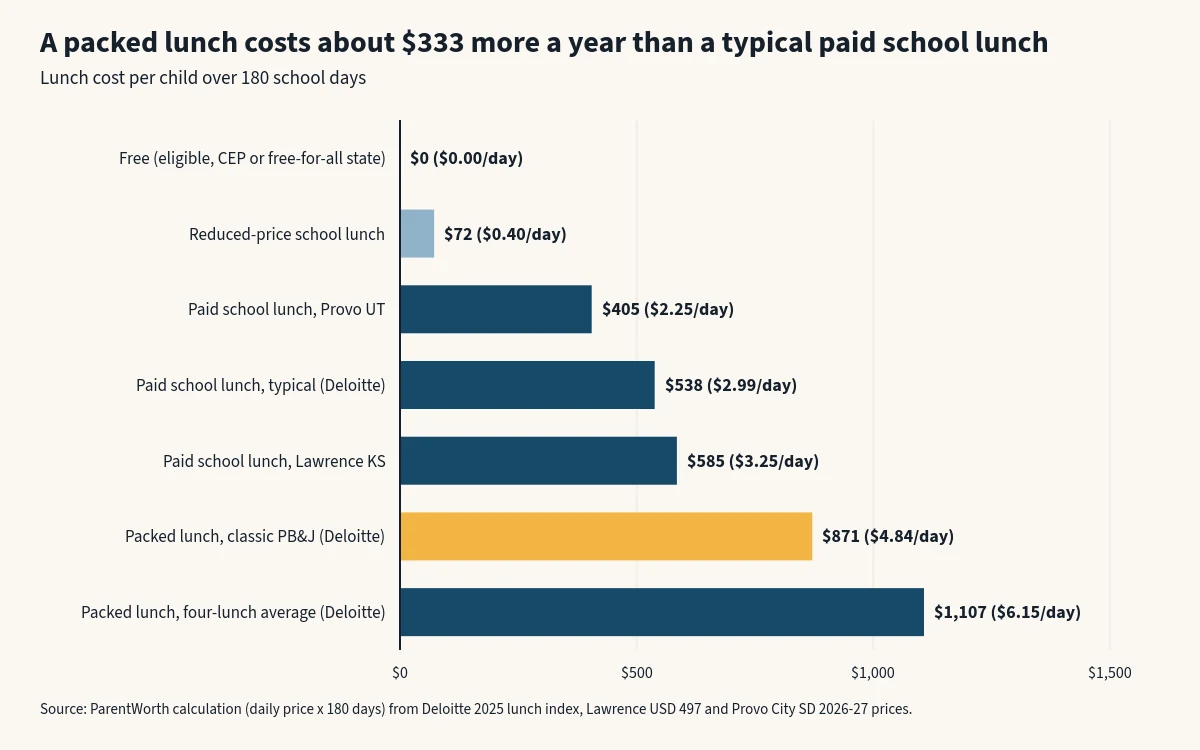
The gap between a classic packed lunch and a typical paid school lunch is $1.85 a day, or $333 a year. At the Lawrence price it narrows to $1.59 a day, or $286 a year.
Put the other way round, packing only comes out ahead if you can build a lunch for less than the district charges. At $3.25, that means about 67% of the cost of the Deloitte classic lunch. Possible, but it takes planning rather than a default.
Who pays nothing, or almost nothing
Before you compare anything, check whether you pay at all. For 2026-27, a family of four qualifies for free meals at or below $42,900 a year, and for reduced-price meals at or below $61,050 (48 contiguous states and DC; limits are higher in Alaska and Hawaii, and they rise with household size).
$42,900
The free-meal income limit for a family of four for school year 2026-27, which is 130% of the federal poverty guideline. The reduced-price limit is $61,050, or 185%.
Source: USDA Food and Nutrition Service, Income Eligibility Guidelines, Federal Register (April 2026).
You may not need to apply. Under the Community Eligibility Provision, the highest-poverty schools serve breakfast and lunch at no cost to every enrolled student, with no household applications. And nine states guaranteed free meals for all public school students as of 2025: California, Colorado, Maine, Massachusetts, Michigan, Minnesota, New Mexico, New York and Vermont. A second list for 2025-26 matches. States change these programs, so confirm yours on your district or state education site.
What is the Community Eligibility Provision?
A federal option that lets high-poverty schools and districts feed all students at no charge, without collecting individual applications. Your school either participates or it does not, so ask the district office or check its meal page.
Costs people forget
Watch out
Deloitte’s packed lunches are priced at ordinary retail list prices, with a side, a dessert and a drink in each one. A lunch built from store-brand staples and leftovers can cost much less than $4.84, and a lunch with more extras can cost more. Price your own lunches for one week before you decide. Your own number is the only one that counts.
Two more costs hide in this comparison. A paid school lunch you do not eat is money spent anyway, and a packed lunch your child half-eats is a half-wasted $4.84. And if your child will only eat from home, packing is not the cheaper option. It is the only one, and the work becomes keeping the cost down.
Scenarios: when the answer changes
Eligible for free or reduced
Household income under $61,050 for four, or a free-for-all school.
School lunch wins: $0 to $72 a year, against $871 packed
Paid, $3.25 district
Full price at the Lawrence rate, and you would pack a classic $4.84 lunch.
School lunch wins by $286 a year per child
Two kids, paid prices
Both pay full price at $3.25, and you would pack the classic lunch for both.
School lunch wins by about $572 a year
The gap scales with every child, which is the same pattern we saw in the one child vs two children comparison: a small daily difference becomes a real number once you multiply it. Packing flips the result only when your own lunch costs less than the district price.
Beyond the money
Money is one input. In Deloitte’s survey, 69% of parents who pack rated home lunches better for taste, and 42% of respondents said their kids bring lunch from home, so plenty of parents pay the premium on purpose. That is a reasonable choice. Just make it knowing the premium is about $1.85 a day, not assuming it saves money.
Time is the other cost. Packing means shopping, prep and cleanup every school day, hours you could price the way we did in the stay-at-home parent vs dual income comparison. For the wider school budget, see the private vs public school cost breakdown, and for the extras that fill an afternoon, the after-school activities cost per hour.
Is it worth it?
Verdict: It depends
School lunch is the cheaper option when your child qualifies for free or reduced meals, attends a free-for-all school or state, or when your paid district price is about $3 or less and you would otherwise pack a $4.84-style lunch. Packing wins only when you can build a lunch for less than the district charges, or when your child will not eat the cafeteria meal.
Decision rules
- If a family of four earns $61,050 or less, apply for free or reduced meals before comparing anything else.
- If your school offers meals to all students at no charge, use school lunch and skip the packed-lunch budget.
- If you pay full price and the district charges less than your home lunch costs, buy school lunch.
- If you want to pack, cost one week of real lunches first and compare the daily average with the district price.
- If you have two or more school-age children, multiply the gap: $286 a child becomes $572 for two at the $3.25 rate.
- If your child will only eat from home, pack and keep it simple, since the comparison no longer applies.
A lunch box for the packing route
If you land on packing, the container is the smallest cost in the picture. A box that lasts three school years of 180 days works out to about 6 cents per school day, on a list price of about $30 (see the maths in the FAQ below). It does not make packing cheaper than school lunch. It just keeps the equipment from being the reason it costs more.
Packing pick: Bentgo Kids Prints leak-proof lunch box
Good for: parents of younger kids who have decided to pack under the rules above. Five compartments, a leak-proof lid and a dishwasher-safe build, sized for ages 3 to 7 according to the listing. For older children, look for a larger box.
Frequently asked questions
Is it cheaper to pack lunch or buy school lunch?
At a paid price, usually school lunch. Deloitte’s 2025 index puts a classic packed lunch at $4.84 against about $2.99 for a typical school lunch, a $333 difference over 180 days. It reverses only if you can pack for less than your district’s price.
Who qualifies for free or reduced-price school lunch in 2026-27?
For a household of four in the 48 contiguous states and DC, the limits are $42,900 for free meals and $61,050 for reduced-price meals, from July 1, 2026 to June 30, 2027. Limits rise with household size and are higher in Alaska and Hawaii. Your district can tell you how to apply.
Which states offer free school lunch to every student?
As of 2025, California, Colorado, Maine, Massachusetts, Michigan, Minnesota, New Mexico, New York and Vermont guarantee free meals for all students, per the Center for Science in the Public Interest. Program details change, so check your state or district before you rely on it.
How many school days should I use for a yearly total?
180 is the most common state minimum, so we used it. Your district calendar may differ by a few days. Multiply your daily price by your actual lunch days for a closer figure.
Is a reusable lunch box worth it?
The container is a small cost. At a list price of about $30 (Bentgo’s site, a different print edition of the same line, October 2026), a box used for 180 days a year over three years costs $29.99 divided by 540 days, about 5.6 cents a day. It will not decide whether packing beats school lunch.
Sources
- Deloitte Insights. School lunch costs and healthy eating. 2025 Back-to-School Survey; accessed October 2026.
- Scripps News. Survey shows parents will pay more for packed school lunches this year. 2025; accessed October 2026.
- Lawrence Public Schools (USD 497). Meal Prices, 2026-2027. Accessed October 2026.
- Provo City School District. Kindergarten lunch and meal prices, 2026-2027. Accessed October 2026.
- USDA Food and Nutrition Service. Child Nutrition Programs: Income Eligibility Guidelines (Federal Register notice). April 2026.
- USDA Food and Nutrition Administration. Community Eligibility Provision. Page updated March 2026; accessed October 2026.
- Center for Science in the Public Interest. Benefits of healthy school meals for all. Accessed October 2026.
- Propel. Which states have free school lunch?. Updated August 2025; accessed October 2026.
- Pew Research Center. 180 days of school is most common (Pew short read, U.S. states). September 2023.
- Bentgo. Kids lunch boxes. List price, accessed October 2026.


1 comment